


AccaMate logo
FIFA World Cup 2026 logo

FIFA World Cup

2026 — The Tournament Of A Lifetime

11 June – 19 July 2026

Host nations

Canada flagCanada
Mexico flagMexico
USA flagUSA

Countdown to World Cup

--Days
:
--Hrs
:
--Mins
:
--Secs

World Cup News

The latest stories, squad announcements, build-up coverage and tournament analysis — direct from FIFA.

The French aristocrat and the all-American idiot: Henry v Lalas is the World Cup’s most compelling battle

World Cup News

The French aristocrat and the all-American idiot: Henry v Lalas is the World Cup’s most compelling battle

Fox’s broadcast at the tournament has become a story of two contrasting styles. And there is one clear winner We all know someone like Alexi Lalas. He’s the ranter whose rants never actually say anything, the life of the party at the party no one enjoys attending, the “big personality” who’s always misjudging the size of the room. He’s corporate America’s idea of a fun guy, the type of workplace “character” whose business trip hangover never stops him from being first at the hotel breakfast buffet, hair wet, Untuckit shirt untucked. He would absolutely dominate karaoke night at a conference on infrastructure finance. If only this were the limit of Alexi Lalas’s actual impact on the world, our culture would live in blessed ignorance of his existence. But in the real world Alexi Lalas is not a small-time menace working the floor at an infrastructure conference. In the real world Alexi Lalas is American soccer’s brightest media star, and he is everywhere this World Cup. When Lalas’s Roger Ramjet jaw thrust into frame on Fox Sports at the start of this tournament, it’s fair to assume that many viewers felt a sense of dread similar to that expressed in the Grand Theft Auto meme: “Ah shit, here we go again.” Lalas’s ubiquitousness every World Cup is American TV’s answer to the Iran War: no one wants it, everyone hates it, and as it drags on, it inevitably becomes a face-saving exercise in damage limitation. But there was also a glimmer of hope: for this tournament Fox has enlisted a pair of elite European strikers, Thierry Henry and Zlatan Ibrahimovic, to terrorize Lalas and shake proceedings up. Steered by Rebecca Lowe, this new-look panel has promised a slightly more sophisticated approach to covering the tournament than the yahooing belligerence that has been Fox’s stock-in-trade at the last two World Cups. Zlatan is a dud, the late-career Samir Nasri of pundits – all minimal effort and visible exhaustion. But Henry is magnificent, which is no real surprise for those of us who follow his work through the Champions League season on CBS. And he has already begun to work his blood-twisting magic on the Maga hack at the far-right end of the panel. Brazil-Morocco, Netherlands-Japan, and France-Senegal have all had their admirers, but for sheer drama and eviscerating beauty they have not come close to matching Fox’s on-set title fight. The French aristocrat vs the all-American idiot: Henry-Lalas is the real battle of this World Cup. Henry’s now-viral humiliation of Lalas in the studio kickaround segment the other day – passing the ball with one foot then dragging it away with the other, leaving the defender with 96 caps for the US men’s national team to dance with thin air – was absolutely filthy, and in the arena of on-set debate the action has been no less processional. This has been less a battle than a slow-motion scalping, and the good news is it still has weeks left to run. In contrast to the gormless agreeability and exhausting talkiness that reign on American TV, Henry is a wonderfully unimpressed on-screen presence, all raised eyebrows, frozen double takes, lip quivers, and ashen shrugs. But he’s more than just an assembly of rehearsed gestures; he also has a lively mind and a sharp sense of humor. Whenever Titi’s sleek dome pops up on screen, you instantly know what you’re going to get: astute in-game observations, learned references to tactical history, and a memorable facial expression or two. Lalas, to use a bit of managerial jargon for players of less refined talents, “offers something different”. Grating contrarianism, relentless jingoism, and a boorish insistence on America as the sport’s future constitute the core of his offering. Lalas enjoyed a solid playing career, but he’s obviously not in the same league as Henry, widely considered the greatest footballer in Premier League history. This vast gulf in on-field pedigree has become more awkward as the tournament has progressed, with Lalas retreating into a meek silence whenever Henry reveals his depth of footballing experience. In a conversation where his co-panelist is casually reminiscing about his days playing alongside Messi or exchanging shirts with Ronaldo Nazário at the World Cup, what exactly is Lalas going to talk about – coming on as a second-half substitute for Earnie Stewart in a friendly against Scotland in 1998? Helping the Kansas City Wizards finish last in the 1999 MLS Western Conference? Did Lalas enjoy an elite playing career? No. But does he do the background reading that might compensate for his relative lack of standing in a conversation with titans like Henry and Zlatan? Also no. But is he charming or funny or charismatic or otherwise magnetic on screen? Eh, no. If Clint Dempsey represents soccer’s version of the American dream – growing up in a trailer park and overcoming poverty, hardship, and family tragedy to become arguably the USMNT’s greatest ever player – Lalas may be the American nightmare: the man who soared into the national consciousness in 1994 in a blaze of kick-ups and flaming hair has ended up an international joke. Once, he sang crunchy dad rock and charmed the Olsen twins; now, he’s on Twitter defending ads during the hydration breaks and quote-tweeting accounts with 197 followers to let us all know how “proud” he is to call the sport soccer, not football (for the last time: WHO CARES?). Contrast this with Henry. The Frenchman’s voice – the hooting vowels, the fleshy emphases, the rounded Rs delivered out the side of the mouth – adds a dusting of Euro flair to everything he says. Among Henry’s many gifts as a broadcaster is an awareness that it is not always necessary to speak loudly to make an impression. Lalas never says anything of substance but when he does open his mouth the emerging inanity is always delivered at full volume: “IT’S GO TIME!” Maybe there was once a time when Lalas offered American soccer a kindler, gentler, more reflective face. But that time is long past. While Lalas rants and states the obvious (“We need Christian Pulisic to step up!”), Henry is a model of cosmopolitan calm – and it’s in this contrast of approaches, rather than any direct confrontation, that the meat of their battle resides. Often over the course of the tournament’s opening days it has felt as if Lalas’s fellow panelists are laboring under a contractual obligation to find him interesting, a burden felt in every strained nod in agreement and forced round of laughter at a signature “bit”. The tirades, the improvised bars, the crescendoes to nothing: Lalas has given us the full package so far this tournament, and his studio mates have dutifully done their best to appear to find the man fun and insightful. In the half-time recap of France v Senegal, Lalas described the French as “lacksadaiscal” (an autological mangling that, in Lalas’s own lazy attempt to pronounce the word “lackadaisical”, unintentionally expressed the very property described), drawing particular attention to the defending on a golden chance for Senegal that Ismaïla Sarr sprayed over the crossbar. “Sarr! Over the bar! Hit it far!” Lalas exclaimed, a trademark rhyme that elicited polite smiles from Lowe and Ibrahimovic. Henry, meanwhile, laughed and shook his head in mock wonder, repeating the words “Sarr over the bar” in the manner of a fond parent congratulating his five-year-old on successfully rhyming “cat” with “mat”. The beauty of Henry’s performance in this epic TV mismatch is that his cloak of Gallic outrecuidance has lent the contempt in which he plainly holds Lalas a measure of deniability. Is Henry mean, or just French? At points Ibrahimovic has made it clear that he shares this disdain for the unquiet American, but he can’t touch Henry’s variety and subtlety when it comes to showing Lalas up. The French legend is not afraid to learn new things and study up on countries and players he’s not familiar with; Lalas gives the impression that he does not need to do any work for the simple reason that he’s American, and America, baby, is No 1. Titi’s contributions in the lead-up to USA v Australia on Friday included an incisive defense of counterattacking football, and a surprisingly deep dissection of the abilities of Socceroos midfielders Connor Metcalfe and Paul Okon-Engstler, two players it’s fair to assume that few in Australia – let alone America – had heard of until a few weeks ago. Over in Seattle, meanwhile, with a crush of American fans at his back, Lalas called Socceroos defender Alessandro Circati “Cicada”. With that out of the way, he returned to regular programming: “America wants to celebrate America and this team is giving America a reason to celebrate America, and man oh man Rob Stone, ain’t that America?” The kind of trollish, hyperventilating garbage that Lalas specializes in is standard fare on sports cable, but it’s a weird fit for soccer, whose global reach compels a kind of analytical modesty. It also runs counter to the sport’s prevailing cultural politics. Soccer in the US is the domain of migrants, urban liberals, and anyone too scrawny for the bigger homegrown sports. There’s a strange mismatch between soccer as it actually exists throughout the United States and the red-meat Americana of Fox’s World Cup coverage, and no one better embodies this incongruence than the network’s resident carrot. While USMNT players expound thoughtfully on the importance of Juneteenth, vocal Trump supporter Lalas is busy doing promo videos for the Department of Homeland Security. (No doubt he would have loved the DHS’s hilarious tweet claiming the US’s heroic defensive effort in the second half against Australia as a variety of Trumpian xenophobia.) For Fox to turn a man as partisan, bullying, and unlikeable as Lalas into American soccer’s figurehead is the media equivalent of getting John Wayne Gacy to perform at a children’s birthday party. But now – improbably and perhaps accidentally – Fox has offered US viewers a living example of how much better they could have it, of what the beautiful game might look like on TV with the Lalasian headlights dimmed. If the culture of American soccer – including on TV – moves in the same positive direction as matters on the pitch, the sport should eventually outgrow Lalas. In years to come, his brand of on-screen thuggery may even be remembered as the relic of a less enlightened era, as a kind of footballing minstrelsy. Maybe the retrospective embarrassment associated with Lexi the loinmaster will be so strong that he’ll be disappeared from the archival footage of this tournament altogether, like a purged party official in Stalinist Russia, and the scenes he once hogged will just show 30 seconds of mystifying silence with Carli Lloyd saying “right on” at the end. We can dream. In the meantime we have this: the vindicating spectacle of a footballing lord showing up on set every day through this World Cup and coolly nutmegging Fox’s house clown into oblivion. In many ways, this is better.

FIFA.com21 Jun 2026
World Cup baby joy for Norway’s Østigård while Doku plans to fly home for birth

World Cup News

World Cup baby joy for Norway’s Østigård while Doku plans to fly home for birth

Belgian’s decision sparked criticism in some quarters Norwegian defender followed son’s birth on video link Family life is intruding on the World Cup for some players in the shape of new arrivals, with Norway’s Leo Østigård following the birth of his first child by video link and Jérémy Doku contemplating leaving the Belgium squad to be with his wife when she gives birth, potentially ⁠missing a key match. Østigård, who has been receiving parenting tips from his teammate ⁠Erling Haaland, provided long-distance support to his partner, Aurora Eidmann, as she gave birth to their ⁠son on Friday. “I’m completely exhausted myself, it was absolutely amazing. ​She did so well, ‌there wasn’t much ‌I could say, I just had to help her work ‌and get him out. I’m proud, amazing,” the 26-year-old said in a video published by the Norwegian FA on its social media channels. “When I saw him for the first time, I was blown away. It’s absolutely insane. I’m ‌so happy and proud. It’s definitely the greatest thing I’ve ever experienced.” Østigård said that shortly after his son was born, the family’s peace was broken by a knock on his hotel room door. “Four lads came jumping into the room. It was probably ⁠Sander [Berge], Erling and Jørgen [Strand Larsen].” Doku’s wife, Shireen, is due to give birth in the second week of July, when the quarter-finals are scheduled. Doku told Reuters: “If you ask me what I want, my answer ⁠is that nobody wants to miss the birth of their first child. But I also know that football involves ​many other considerations. I know the federation ‌supports its players and understands their ‌situations. We’ll see what we can do.” Belgium’s campaign started with a 1-1 draw against Egypt and Doku missing a match to be at the birth would appear to hinge on them not only advancing from their group but winning two knockout ties. Nonetheless, there has been criticism in some quarters, with France Pierron, a French television journalist for L’Équipe, saying of Doku: “You’re living out a childhood dream, yet you’re going to walk away ‌from it all to attend the birth of your child – a disgusting moment, if you’ll pardon the expression, where the dad is completely useless.” However, the remarks from Pierron have provoked a considerable backlash, with the newspaper Libération describing her comments as “the reaction of another age”. She subsequently posted: “I was expressing a personal opinion within the context of a debate. These remarks are solely my own and in no way reflect a collective position. I understand that they may have shocked, offended, or hurt some of you, and I am sorry for that. My intention was never to minimise the place or role of fathers with their partners and children.” As it is, Doku will miss Belgium’s Group G game against Iran on Sunday because he has not recovered from a respiratory infection. Østigård, meanwhile, can look forward to playing Senegal ​in Group ​I at the New York New ​Jersey Stadium with a weight off his mind. He said: “I think it makes me ​a little ‌more relaxed, ​that everything ​has gone well, because you never know. Now it’s just joy and I’m very happy that things are good, and that my boy is out.”

FIFA.com20 Jun 2026
No Pulisic, no problem: how the USA learned to win without their star player | Jeff Rueter

World Cup News

No Pulisic, no problem: how the USA learned to win without their star player | Jeff Rueter

Mauricio Pochettino had to do without his best player against Australia. But Ricardo Pepi helped the Americans build attacks in different ways Once it was clear that Christian Pulisic’s calf could keep him out of Friday’s match against Australia, Mauricio Pochettino had a lot of options to consider. There is no like-for-like alternative to Pulisic, still the United States’ most important player. Australia entered this game with a point to prove, wanting to build off of their opening win over Turkey with a statement result against the tournament co-hosts. As was the case when the teams met for a friendly in October, the Socceroos were set up to operate in a low defensive block, with five along the backline and a swarming, zonal marking scheme in front of them. That system can be quite effective against a team who play with just one striker, as the US have for most of the 21st century. When the lineups dropped, there was just one change from the US side who bulldozed Paraguay 4-1. There was no Pulisic. In his stead was Ricardo Pepi, who would play alongside his fellow center-forward Folarin Balogun. It seemed like a risk for the US to forego their usual numbers in midfield, but it proved to be a gambit rather than a gamble as the US strolled to a 2-0 half-time lead they maintained until the final whistle. “I feel like it opens up some spaces, of course, but you know it’s always good to be able to have two strikers,” Pepi said after his first World Cup start. “If the defenders are marking me, then the other [striker] is always free. So it’s a good thing that we were able to play like this, and it just shows what the team has.” What the team have is chemistry, after years playing alongside each other at youth and senior levels. Coupled with a few weeks to train together, the US look far better rehearsed with their movement patterns, and it’s putting even the sturdiest of opponents’ low-blocks in two minds. The first time the US truly tested the Socceroos on Friday they scored. It was the second straight match in which they had forced their opponents into an early own-goal. In the 11th minute, after the US had already tested Australia from each side, Antonee Robinson collected a pass from Tim Ream as he has countless times during his career. When Pochettino’s US play with two attacking midfielders, as they do when Pulisic is on the field, Robinson’s instinct has been to look for either his holding or attacking midfielder to get the ball back into the half-space. Against Paraguay, sequences like these kept the South Americans on their toes and allowed the US to put together dizzying patterns of play. Adding a second striker makes the more direct route even more advisable as any downhill sprint can be supplemented with adequate support. Robinson gave Australia a test with a ball up the line, having already drawn wing-back Jacob Italiano too far upfield to nullify the threat. Balogun recognized the space and made a run to create an opportunity. The US found themselves with a similar sequence in their recent friendly against Senegal. In that match, Sergiño Dest popped up to offer Pulisic a crossing option after Pepi had dropped deep to help with build-up. On Friday, with all three Australian center-backs still stationed at the edge of their defensive third, this ball left the US with an advantage of pace as the midfielders and wing-backs scrambled to support. “I mean, credit to [Balogun],” Robinson said after the match. “I could see that he was looking to run the space in behind, so I just kind of played it down the channel for him, and then he’s done a lot of work to get towards the goal and create a chance.” Despite seldom operating as a winger in his career to date, Balogun attacked the space presented to him, confident that he could stay a step ahead of Alessandro Circati. Pepi kept doing center-forward stuff as the sequence progressed and made a run up the heart of the pitch. Although Balogun had scored a brace against Paraguay, Australia would have been reckless to ignore Pepi, who bagged 16 goals in 26 league games for PSV this past season. Balogun bypassed Circati and was running out of room. But he had ideal options available to him in the heart of the box. Cameron Burgess had done just enough to get between Balogun and his teammates and desperately tried to prod the ball out for a corner kick. But under pressure, Burgess instead put the ball past his own keeper to reward Balogun’s industry. The gambit had paid off quickly. Australia’s defense were in two minds from the opening whistle, with their center-backs occupied and unable to lock down on Balogun as intended. “I want to be dangerous,” Balogun said after the win. “I want to create opportunities, and it might not always be myself that scores, but if I can force an error that gives us the lead, then for me it’s like a goal as well.” Pepi’s presence in the box also helped on the second goal. As Robinson prepared to take a free-kick at the end of the first half, Australia had to contend with the threat of three US center-backs and two strikers, including Pepi – prime targets for deliveries like these. Dest loitered around the edge of the area, and Australia’s panicked defenders ran to mark him as he received Robinson’s free-kick. That left the Socceroos’ defensive block unsettled, meaning Alex Freeman was open when Dest’s shot took a deflection and the ball headed towards the Villarreal defender. From there, the second half was far easier for the US to control. Australia had committed to being difficult to break down in the hope of nicking a goal or two, as they had against Turkey. The Socceroos made three substitutions at half-time but the changes did little to boost their attacking threat. Pepi kept doing what he was asked to do as he occupied defenders and found space. That, coupled with his pressing, made him a valuable alternative to Pulisic, despite having a very disparate job description. For Pepi, who was harshly left off the last World Cup roster, it was a memorable start that should earn him more playing time moving forward. No matter who is in the lineup, this group is confident they can adapt on the fly and keep the initiative. “Whether it’s coming to feet, running off the ball, we’re all trying to create options for each other,” Robinson said. “It feels fluid. Everyone feels like they’re linking up really well, and hopefully we keep going with it.”

FIFA.com20 Jun 2026
Scotland rue ‘50/50’ penalty calls in defeat: ‘Morocco got away with one there’

World Cup News

Scotland rue ‘50/50’ penalty calls in defeat: ‘Morocco got away with one there’

McGinn and McTominay involved in strong appeals Clarke questions if Diop should have been sent off Steve Clarke believes Scotland were unfortunate not to be awarded at least one penalty during their 1-0 defeat to Morocco. In separate incidents, John McGinn and Scott McTominay appealed vociferously for spot-kicks under challenges from Moroccan players. McGinn later insisted a Morocco defender Neil El Aynaoui “took me out”. While Clarke steered well clear of castigating the match officials, he clearly felt the decisions were borderline and suggested Morocco’s Issa Diop could have been red carded early in the game. The deciding goal arrived after just 70 seconds, with Scotland spirited in the second half. “Everyone when I did my television interviews was talking about the Scott McTominay one,” Clarke said. ‘That is the one I didn’t watch back. I thought the John McGinn one was 50/50. Some would give it and I think if the referee gives it, the VAR doesn’t overturn it. So I can only speak on that one.” Clarke volunteered opinion on Diop, who was booked for a foul on the Scotland striker Ché Adams. “I was a little but 50/50 as well on the Ché Adams [challenge], last man,” Clarke added. “He had a chance to go through one on one with the goalkeeper and is brought down. The referee chooses yellow. There is nothing we can do about it.” Assessing his own incident, McGinn said: “Sometimes that goes for you. If we got a couple of those penalty decisions for us, I don’t think VAR intervenes. Out the corner of my eye, I could see [the Morocco defender] charging in. I got first contact to the ball and he took me out. It’s a penalty kick for me. Sometimes you get them, sometimes you don’t. If it was given on the field, no chance it’s overturned. “Morocco have got away with one there. But we need to be better and create chances from open play, not rely on referee’s decisions.” Scotland’s attention will shortly turn to Wednesday and a game with Brazil in Miami which will determine whether they advance from the group stage for the first time ever. “I am proud of the players but obviously we are all devastated,” said Clarke. “The players will suffer a bit over the next 48 hours. They don’t like losing against anybody. “Right throughout the team, Morocco had a bit of class. But we gave it a good go. Morocco know they have been in a game tonight. We have shown we can compete at this level.” Clarke, who singled out Lewis Ferguson for praise for a second game in succession, allayed fears over the second-half injury sustained by Kieran Tierney. Scotland’s manager said Tierney had only suffered cramp before being replaced by Ben Gannon-Doak.

FIFA.com20 Jun 2026
US players agree with Zlatan Ibrahimovic that World Cup title is possible: ‘That’s our mindset’

World Cup News

US players agree with Zlatan Ibrahimovic that World Cup title is possible: ‘That’s our mindset’

US qualify for knockout stage after victory over Australia Former Sweden striker says Americans are contenders US men’s team’s last semi-final came in 1930 After two wins in two to start the World Cup, the US have gained a high-profile supporter: Zlatan Ibrahimovic. Asked on Fox’s postgame broadcast whether he thinks the co-hosts can win the World Cup, the Swede offered a simple answer: “Yes.” Asked about Ibrahimovic’s comments after Friday’s 2-0 win over Australia, US players were uniform in their response: Sure, why not? “I don’t think it’s ridiculous,” Chris Richards said. “We want to lift a trophy by the end of this.” His fellow defender, Auston Trusty, had similar feelings. “That’s our mindset,” Trusty said. “I don’t think you enter this tournament not to have that mindset. To have [Ibrahimovic] say that about us, that’s amazing. But I’m sure he knows as well, it’s game-by-game.” If the US do make it deep into the tournament – Friday’s win guaranteed their spot in the knockout stage – it will likely be due in no small part to the emergence of Alex Freeman. The 21-year-old defender, now at Villarreal after becoming one of the best young players in MLS with Orlando City, has been a revelation at this World Cup. Playing on the right side of a three-man backline, Freeman scored the second goal to seal Friday’s win – a goal that was initially ruled out for offside but was later given after a lengthy VAR review. “I think you dream of this moment,” said Freeman, the son of Super Bowl champion Antonio Freeman. “And for it to finally happen with such a support system to help you celebrate it makes is so much more special. When it was confirmed, I saw all my teammates running and I thought: ‘I’ve got to run away, they’re going to tackle me!’” Mauricio Pochettino said at his introductory press conference as US head coach that his goal is to win the World Cup with the US. He too had praise not just for Freeman, but the system that developed him. “The evolution is massive,” Pochettino said after Friday’s game. “He has potential to be one of the best players in his position in the world. He’s [a] humble guy, he has an amazing profile. He wants to learn. He always listens … you really enjoy being with him.” The best US finish at a men’s World Cup was third-place in the tournament’s first edition in 1930. Their best result in the modern era was a run to the quarter-finals in 2002.

FIFA.com20 Jun 2026
Socceroos crash back to earth after being humbled by superior USA | Jack Snape

World Cup News

Socceroos crash back to earth after being humbled by superior USA | Jack Snape

The swagger Australia offered in their opener against Turkey was gone and for much for the game in Seattle they looked second best and shellshocked Australia looked like a bunch of bananas in their all-yellow strip against the USA, and it is tempting to call this comprehensive 2-0 defeat a banana skin in the Socceroos’ World Cup campaign. In truth, however, this was less a slip up than a humbling, and the visitors proved ripe opposition as the hosts came and took what they wanted. After the celebrations against Turkey, and the optimism of the past week, this was a jarring correction for Australia and their 10,000-strong travelling fans. The Socceroos looked second best and shellshocked for most of this early afternoon fixture. The swagger they offered against Turkey appeared to be luggage lost somewhere between Vancouver, just a few hours’ drive to the north, and their training base in Oakland. Compared to the Socceroos’ opening match, this opposition was improved – seemingly winning every 50-50 contest, all the time faster and more physical – but at the same time this Australian team was one that was hard to recognise. Before kick-off, Nishan Velupillay was out on the field in slides familiarising himself with the imposing Seattle Stadium alongside Mo Touré when the team news landed. The Melbourne Victory forward was named a surprise starter, along with Mat Leckie from crosstown club Melbourne City. It was a selection that raised eyebrows. Out was Nestory Irankunda, star of the previous week’s clash against Turkey. He walked into the dressing room wearing dark sunglasses, making his mood difficult to interpret. The other goalscorer in that 2-0 win, Connor Metcalfe, was also moved to the bench. Coach Tony Popovic had been rewarded for his risk-taking in Vancouver. The same cannot be said against the USA. Leckie and Velupillay not only struggled to make an impact going forward, they were unable to protect the fullbacks behind them. Down Australia’s left, Weston McKennie was a constant menace, assisted by Sergiño Dest. The raids made even Jordy Bos, so comfortable last week against Turkey, look vulnerable. The fullback picked up a yellow card in a miserable first half, and was manhandled by the American right flank, with Alex Freeman also looking assured at full-back. When the half-time whistle went, Bos’s frustrations almost boiled over, as he argued with the Americans as he wandered off. Despite the Americans’ threat down their right, the opener came from the opposite side. A belated Socceroos press gave Antonee Robinson time to measure a pass to Folarin Balogun, who accelerated past Alessandro Circati. His square pass across the six-yard box was awkwardly toed into the net by an unfortunate Cameron Burgess. That was the trouble for Australia. Bos, Circati and Burgess were three who looked among the Socceroos’ most accomplished against Turkey. In Seattle, the Americans began the humiliation of the Socceroos from the top. The second goal may have been fortunate – a deflected shot wrong-footing Patrick Beach before the headed finish by Freeman – but it was no less than the USA deserved and came just before half-time. Popovic appeared to recognise the error of his ways with a triple substitution at half-time, including the introduction of both Irankunda and Metcalfe. Christian Volpato came on for his World Cup debut not long after, and soon had the Socceroos’ best chance. In an improved second half, Volpato – whose commitment to Australia has been questioned – appeared to show more fight than anyone, at one time urging the yellow stripe in the stands behind the goal for more noise to aid a comeback, however unlikely it appeared. Metcalfe and Irankunda were also involved heavily, the latter proving relentless for the American defence, as he went toe-to-toe with Crystal Palace defender Chris Richards on more than one occasion. The signs of life however came too little, too late, and proved to be ultimately too faint. A couple of decent shots saved well by American keeper Matt Freese and a Jason Geria effort blocked in a goalmouth scramble was as close as they came to a goal in the second half, even if the Australians enjoyed more of the ball and field position. The latter stages were hard to watch, as the game descended in a physical tit-for-tat with the result beyond doubt. Fortunately for the Socceroos, the thumping is not fatal. Yes, they gave up a golden opportunity to book their place in the round of 32, but they remain well-placed to progress through Group D. Those three points secured against Turkey will prove invaluable in their quest for a knockout berth, but they may now need to avoid defeat against Paraguay in San Francisco next week – depending on what happens later on Friday (Saturday AEST) in the group’s other match. The first tiebreaker in the group stage is head-to-head, if points are level. So while the Socceroos can no longer catch the Americans, and are guaranteed to leave their home base of San Francisco if they do progress, they remain a likely qualifier in either second or third position. Unless they can drastically improve on this performance in Seattle, however, the Socceroos may not be in North America for much longer.

FIFA.com19 Jun 2026
Elliot Anderson is England’s spirit animal – and is now indispensable

World Cup News

Elliot Anderson is England’s spirit animal – and is now indispensable

With Declan Rice nursing a knock, his midfield partner is the reliable rock to which team’s fate is inescapably yoked Elliot Anderson is running. It’s the 88th minute against Croatia, and the game is won, and the game is done, and this is the 60th game of his season and there are deeper challenges to come. But as long as the ball is loose, he’s going to chase it down: first Josip Sutalo and then Josko Gvardiol, a simple recycling of defensive possession rapidly mutating into an unpleasant ordeal. As the ball is worked across defence, Anderson single-handedly follows it all the way across the pitch, over to the far touchline, where he eventually forces a rushed pass and a turnover of possession. And in an opening win defined by mood swings and tectonic shifts, in a team savouring the wealth of options and contingencies at its disposal, it’s worth dwelling on just how quickly Anderson has become indispensable. Declan Rice is carrying a knock and looks a little short of gas. Harry Kane will almost certainly not have the legs to play eight full games plus extra time. The wingers, the centre-half pairing, the full-backs are not yet set in stone. Beyond Jordan Pickford, virtually every area of this team is operating in a kind of managed flux. In the midst of which Anderson has assumed the role of its spirit animal, its mathematical constant, its barometer, the reliable rock to which – for better and worse – England’s fate over the coming weeks will be inescapably yoked. In short, if you want to know how England are doing in the coming weeks, you basically just need to watch him. Central to Anderson’s role, paradoxically, is the fact that it is not always a central role. Indeed, if you look at his heat map from the Croatia game the most striking element was how much of it he spent in wide areas: linking play with the full-backs, creating overloads and triangles, playing the first-time long ball over the top that appears to be a specific and very deliberate tactic. In essence, it works like this: Reece James gets the ball on the right touchline. Draws the pressure from the opposing winger. Retreats towards his own goal, waits for Anderson to run towards him, and then plays a little sideways pass inside. Anderson then launches it first touch, rugby-style, into the right channel for one of the forward runners to chase. A simple move, but one that requires coordination, the physical strength to hold off the challenge, and a clean ball contact. Done right, it successfully provokes the opposition press, drags them out of position, forces them to turn and run. In the 36th minute, we got a glimpse of what happens when it’s not done right. Anderson fluffed his lofted pass, Croatia won back possession and a few seconds later Martin Baturina had equalised. But then, shortly after half-time, the same move worked to perfection: James inside to Anderson, Anderson first-time up the touchline, and with the Croatia defence scrambling Jude Bellingham converted beautifully. Even here there are caveats to offer. Anderson’s pass was almost intercepted by Gvardiol, and probably intended for Noni Madueke rather than Bellingham in any case. Clearly, Thomas Tuchel has drilled this move in advance against teams enterprising enough to press England high. But what happens against opponents who either do not press, or press better than Croatia, or who are wise to the tactic and lurk in ambush? And really, these are questions that strike at the broader theme of what Anderson’s function in this team should really be, how best to use a player who in terms of skill set may well be one of the complete young midfielders English football has ever seen at his age. Anderson can genuinely do it all: pass, tackle, screen, jockey, cross, shoot. He’s good in the air, strong in duels, delivers a mean set piece, will quite literally run all day. Is there a realistic role in this team that does not, in some way, sell him short? Curiously, as the game opened out in the second half we got an answer of sorts. Rice went off; first Bellingham and then James slotted in to replace him; Anderson moved over from the right side of midfield to the left. As a right-footer, the first-time ball over the top from Nico O’Reilly was no longer an option. But instead, he offered much more of an individual threat. He bombed on into the area. He pressed much higher than in the first half. Partly, of course, this was a shift dictated by the momentum of the game. But it was a reminder, if anyone ever needed it, that this is a midfielder with so many different tools to his game. It was interesting to watch an interview Anderson did with the BBC last month, in which he explained how his role has evolved since his days as a winger or No 10 at the Newcastle academy, and how he sees his role on the pitch now. “Six or eight, I really don’t care,” he said. “Getting on the ball and finding the attacking players, getting them the ball early in the pockets and letting them do their stuff.” This is, of course, why Tuchel adores him: the ability to take the ball, ride the challenge, move it on early and forwards. All the same, it is worth asking whether punting long balls up the channels is in fact the best use of him. In hotter conditions, against the weaker opponents who will sit back, and the stronger opponents who will try to dominate midfield, where poise and control of the ball will be critical, England will need to show different sides to their game, measure the risk and reward a little more judiciously. Ultimately, this comes down to an assertion of principle. Do you want to keep the ball in midfield, or get it out of there as quickly as possible? And in the deployment of Bellingham and James to replace Rice in the second half, the decision to leave Kobbie Mainoo on the bench and Adam Wharton at home, Tuchel has made his priorities subtly clear. He appears less concerned with midfield control than midfield mobility, as preoccupied with physical resilience as technical ability. Anderson can do it all. But sometimes being able to do it all can be a double-edged sword. The roads are littered with prodigious young midfielders who seemed destined to rule the world and eventually had to settle for being quite good: Eduardo Camavinga, Saúl Ñíguez, Rúben Neves. Even Gavi and Warren Zaïre-Emery, now 21 and 20, have already lived through at least one cycle of boom and bust, struggled to reconcile their developing game with the explosion of teenage hype they inspired. Anderson is 23, but a comparatively late developer with just two seasons of regular top-flight football and one major tournament game behind him. Already, Manchester City are circling and a nine-figure transfer feels inevitable. This is a player about to arrive in a very big way. And perhaps this is what makes him so compelling to watch right now. You know that on some level he must still be raw and fragile, and yet he never really looks it. You know that his importance is colossal, and yet he never seems fazed by it. You know at some point he will have to stop running. And yet, what if he never does?

FIFA.com19 Jun 2026
Who are Morocco's players to look out for against Scotland?

World Cup News

Who are Morocco's players to look out for against Scotland?

After beating Haiti in their opening game, Scotland face a step up in class against Morocco, who are unquestionably a rising force in world football. The Atlas Lions became the first African and first Arab nation to reach a World Cup semi-final in 2022 and have built on that momentum. They are ranked sixth in the world and showed that is no anomaly with an impressive display versus Brazil on Saturday, earning a deserved 1-1 draw against the five-time world champions. BBC Sport takes a look at five key players Scotland need to watch out for. Club: Lille Age: 18 Position: Midfielder Caps: 4 Goals: 0 The teenage playmaker only won his first cap shortly before this tournament but announced himself on the world stage with a midfield masterclass against Brazil. He combined effective defensive work and elegant ball-carrying with metronomic distribution, completing 60 of 66 passes and running rings around Casemiro, who was taken off at half-time. But the performance came as no surprise to head coach Mohamed Ouahbi, who said afterwards: "We knew perfectly well what kind of player he was, that's why we had so many meetings to get him to choose Morocco". Bouaddi was born in France to Moroccan parents and was playing for Les Bleus' under-21 side only three months ago. He switched allegiance last month. Though only 18, Bouaddi has already made 96 senior appearances for Lille. The 6ft 1in player is a prodigy in every sense. He took the equivalent of his A-levels a year ahead of his peers and is combining football with a degree in mathematics, reasoning that keeping his mind alert helps him "understand the game quicker". Club: PSV Eindhoven Age: 25 Position: Attacking midfielder/Forward Caps: 31 Goals: 10 Morocco had success against Brazil by deploying Saibari as a false nine – a ploy which paid off as he put his side ahead with an intelligent run into space and a nonchalant chip over Alisson. Whether or not he plays the same role against the Scots, Saibari is a major threat and arrived at this tournament as Eredivisie player of the year after a career-best 19 goals in all competitions in 2025-26. Though born in Spain, he moved to Belgium at an early age, spending time in the youth academies of several Belgian clubs before making his PSV debut in 2020. The 25-year-old was involved in a bizarre incident in January's Africa Cup of Nations final, when he and several Moroccan ball boys tried to prevent Senegal goalkeeper Edouard Mendy from retrieving a towel to dry his rain-soaked gloves. He later apologised to Mendy and was given a one-match ban, with another game suspended. Club: Al Hilal Age: 35 Position: Goalkeeper Caps: 91 Clean sheets: 52 Bounou made several important saves to preserve a point for his side against Brazil, in the process becoming his country's oldest player to feature at a Wo3rld Cup. Known as 'Bono', he played a key role in Morocco's run to the semi-finals in 2022, saving two penalties in the last-16 shootout win against Spain. He was awarded the prestigious Order of the Throne by King Mohammed VI for his heroics in Qatar. Bounou was born in Montreal but grew up in Casablanca and made his name during 11 seasons of club football in Spain. A two-time Europa League winner with Sevilla, the former Girona and Zaragoza goalkeeper joined Al-Hilal in Saudi Arabia in 2023-24. Diaz's perfectly weighted through ball for Saibari's opener on Saturday was arguably the pass of the tournament, bisecting Brazil's backline in a moment of individual brilliance. The 5ft 7in player made headlines around the world when he missed a casually-taken 'Panenka' penalty in the Africa Cup of Nations final against Senegal in January - although he had scored five goals in the first five games of the continental tournament. He was born in Malaga to a Spanish mother, while his father was born in Melilla - a Spanish city on the North African coast - into a Moroccan family. Diaz joined Manchester City as a 16-year-old in 2015 and made 16 appearances - earning a Premier League winner's medal in 2017-18 - before joining Real Madrid seven years ago. Club: Manchester United Age : 28 Position: Defence Caps: 45 Goals: 2 The Manchester United full-back has played in six different positions for club and country over the past two years, including an attacking midfield role, although he is most likely to start at left-back for the Teranga Lions. Mazraoui was a key member of the Morocco side that reached the World Cup semi-finals in 2022. After he was substituted in the last-four defeat to France, it emerged he had been suffering from inflamed heart tissue after contracting Covid-19 during the tournament. This article is the latest from BBC Sport's Ask Me Anything team. Everything you need to know about the World Cup

FIFA.com19 Jun 2026
Players are human beings and social media comments reach us. But the focus has to be on the pitch | Rodrygo

World Cup News

Players are human beings and social media comments reach us. But the focus has to be on the pitch | Rodrygo

The pressure of wearing the Brazil shirt can be heavy but also creates a positive kind of responsibility Playing in a World Cup is a huge experience; when you’re with the national team, your entire focus is on the squad’s schedule – the hotel, the training centre, the stadium – basically, everything revolves around the matches. I lived that routine daily at the 2022 World Cup and realised the immense dedication the tournament demands. In this 2026 edition, as fate would have it and as I am still recovering from my injury, I’m discovering a different side of the World Cup: a World Cup of reunions, with countless events happening simultaneously across the cities and countries, creating opportunities for conversations and extraordinary experiences. Over the course of two afternoons in New York I ran into true legends, icons, and friends I’ve made through football. They were precious moments where I could listen, exchange ideas and receive support from stars such as Marcelo, Kaká, Paul Pogba and Zinedine Zidane. What started as a scheduled appearance for a shared sponsor turned into a casual, friendly chat from different generations united by the passion football ignites. We were right there, close to the fans. Five guys representing Brazil and France, greeted by hundreds of fans from all over the globe, all hoping for a brief moment of proximity, a photo, or a wave. And yes, I have idols too; I managed to get an autographed shirt from Zidane, my former coach and a giant in the history of the sport. Sharing that space in the centre of the event arena next to the Brooklyn Bridge, we talked about past experiences, the energy that spreads everywhere during the World Cup, and, of course, the matches that had already taken place. Naturally, everyone expects the best from the Brazilian national team, and in football “the best” means victory. But it is important to remember the opening draw against Morocco was the first step on the journey; Brazil fell behind in the game and securing a draw was important for the road ahead. The World Cup presents challenges unlike any other competition. Scenarios shift constantly, and almost nothing is set in stone. If things don’t go as planned in the first game, it doesn’t mean the rest will follow the same pattern. By the same token, a big win does not guarantee the next match will be any easier or that performance levels will remain consistent. It is a sprint-paced marathon with stages that feel independent of one another, creating opportunities for change throughout the journey that makes up the whole. There are eight decisive matches on the road to the title and, in the group stage, not every setback means that you are going home. A single team can be several different versions of itself over the course of the tournament – and that is one of the factors that makes the World Cup incomparable. When we are on the pitch for a World Cup match, our eyes and minds have one undisputed priority: to perform our best. We have done everything possible to arrive in the best possible physical, technical, tactical, and mental shape. Everyone there defends the team and the country with everything they can. Before and after matches, opponents are fellow professionals and friends. But once the game kicks off, everyone focuses on their job and gives their all to help the Seleção advance. You can’t predict the result, but you can guarantee dedication and the right attitude by leaving everything on the pitch. The pressure of wearing the Brazil shirt can be heavy but also creates a positive kind of responsibility. That pressure exists solely because of the greatness of our football, the titles we’ve won, and our historic standing in the sport. The fans’ mood often hinges on the result, which is only natural in a country so used to winning regularly. So, as a player you have to realise that a barrage of criticism isn’t the end of the world, just as a massive wave of praise doesn’t mean everything is sorted out and that you will win the tournament. It is crucial to distinguish facts and balanced analysis from comments born of raw emotion and frustration. Players aren’t immune to what is said on social media. I believe in using a filter: a process of separating what is relevant, what deserves a response or consideration from what is simply garbage, intended to cause hurt and completely detached from reality. A World Cup player’s daily routine involves dedicating a vast amount of time to the profession. Yet, the player is a human being who communicates – even if only online – with friends, family, professional contacts and fellow players. Consequently, social media comments can easily reach them through any of these channels. Among the messages received, there may be content intended to cause distress or trigger stress. A football player is a human being who can be affected by such photos, videos or comments – just like anyone else. We do not go out of our way to seek them out or read them; most players do not actively look for comments and have a support team that handles the filtering process. At times, though, the sheer volume means some of it reaches us. Then the focus must remain on performance on the pitch. It is up to us to ensure that our on-field performance is what truly speaks loudest.

FIFA.com19 Jun 2026
Lionel Messi’s family ask for ‘humanity’ as his father receives medical treatment

World Cup News

Lionel Messi’s family ask for ‘humanity’ as his father receives medical treatment

Jorge Messi, 68, ‘recovering and progressing favourably’ ‘At times like these, we ask for responsibility,’ says family Lionel Messi’s father is undergoing medical treatment for an undisclosed illness and his family asked the media for “humanity” on Thursday amid rumours about Jorge Messi’s health while his son competes at the World Cup. “Jorge is going through a health situation,” the Messi family said in a statement. The family did not specify the illness that the 68-year-old Jorge Messi is suffering from. “He is currently under medical observation, recovering and progressing favourably within his current condition,” the statement said. Messi said after Argentina’s 3-0 victory over Algeria in the team’s opening World Cup match that he was going through a difficult personal situation. He did not elaborate. The family statement, released by Messi’s media office, came on the same day that reports of Jorge Messi’s death circulated in Argentina. “At times like these, we ask for responsibility, prudence and humanity,” the family said. “A person’s health and the peace of mind of their loved ones should not be the subject of speculation or irresponsible media interest.” The statement said any further developments would be communicated by the family.

FIFA.com18 Jun 2026
Barry’s blunt England home truths give TV viewers a glimpse of dressing-room vibe

World Cup News

Barry’s blunt England home truths give TV viewers a glimpse of dressing-room vibe

Assistant manager’s half-time interview on ITV offered an unexpectedly honest insight into the in-game mood in the camp England’s players have been effusive in their praise for Thomas Tuchel’s half-time talk, but the half-time talk that ITV viewers in the UK got was very different, in the form of a refreshingly frank interview with his assistant, Anthony Barry. In-game interviews of staff are another novel broadcasting feature of this World Cup, like the innovative use of refcam, but, rather than fob off a reporter with some meaningless platitudes about the lads giving it 110%, Barry gave an honest assessment of the team’s failings up to that point. What Barry served up was not the usual scripted optimism but a raw autopsy of England’s opening-half paralysis, pinpointing that the team were suffering from an excess of nervous energy in what he described as a “complicated and confusing” 45 minutes. He criticised the mentality of the players for falling into “fearful patterns”, and making the wrong decisions – as he put it, “Playing longer when we should play short, playing short when we should play long, and not playing through the gaps, not allowing us to accelerate our game the way we wanted to.” Barry was honest enough to admit that even the gift of an early penalty had not settled the team. Saying that nervous energy was “maybe expected in the opening game of a World Cup”, he nevertheless lamented that the early goal did not free the team up “to play more like ourselves”. He didn’t offer a smile for the cameras. He finished with the blunt assessment: “We conceded the second goal late on, and now we have to speak about that at half-time,” leaving viewers with the distinct impression of a man heading down the tunnel with a clipboard full of problems to solve. During his playing days as a midfielder, Barry knocked around the lower leagues with spells at Yeovil Town, Chester City, Fleetwood Town and Forest Green Rovers, but if he isn’t a particularly familiar face to TV viewers – yet – he is very much a familiar face to Tuchel. After launching his coaching career in 2015 and working with Wigan, Barry joined Chelsea in 2020, where he served under Tuchel before following the manager to Bayern Munich in 2023. Alongside these club roles, Barry built an impressive international resume assisting the Republic of Ireland, Belgium and Portugal, before stepping in to the England assistant manager role. His on-screen diagnosis of an England performance that delivered an inspiring result but which was far from flawless mirrored Tuchel’s assessment after the final whistle. The German said “sometimes you want it too much and you overthink it” before noting that there were far too many backward passes for his liking. “I told them to calm down,” Tuchel said of his half-time talk. “To calm down, calm their nerves. And encourage them to do it our way.” Armchair viewers of England’s World Cup campaign look as if they could get to enjoy an unprecedented insight into what the management team are about to tell the players in dressing room.

FIFA.com18 Jun 2026
What's going on with stoppage time at the World Cup?

World Cup News

What's going on with stoppage time at the World Cup?

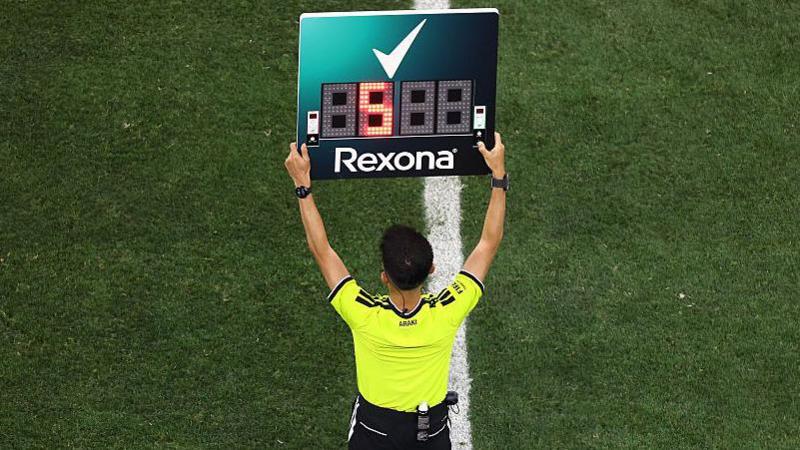
Even factoring in the three minutes for the hydration break, the added time has been surprisingly low - sometimes only five or six minutes going up on the board. In Qatar, matches were lasting on average more than 100 minutes. But at this tournament - ignoring the time for hydration breaks - matches are clocking up 96 minutes. "The goal we want to achieve is to increase the tempo of the match," Collina said ahead of the finals. Collina introduced a number of measures, such as putting five-second countdowns on goal-kicks and throw-ins. Tactics were introduced to try to limit how teams would break up games, by placing a 10-second clock on substitutions and forcing players who require treatment to stay off the field for one minute. The changes have, so far, been well received in the United States, Mexico and Canada. But do the stats show that Collina's masterplan is actually working? Collina's philosophy was pretty simple. If you stop players taking too long over the mundane tasks, that time could be given back to the game without adding it on at the end. "The objective is to eliminate, as much as possible, the disruption of the tempo of the match," Collina explained. This was never supposed to be about awarding loads of corners, or being strict on substitutions. The aim was to change behaviour or, as Collina put it, "players will respect the limit". Only one goal-kick has been changed to a corner, when DR Congo took too long during their 1-1 draw with Portugal on Wednesday. There have been no cases of a substitute not being allowed to enter the pitch because the substituted player has taken too long to leave the field. So you have to forget about the old way of doing things, like adding 30 seconds for each sub. Now players leave the field within 10 seconds. For that reason, you might see substitutions take place in stoppage time and no more additional time added. It at least feels like there have been fewer stoppages for injuries, while referees have been quick to tell some players they must go off even if they don't have the physio on. The threat of playing with 10 men for at least a minute appears to be working as a deterrent. The video assistant referee checking corners does not seem to have impacted games, though Fifa has many more video match officials and enhanced technology which would not be available to the domestic leagues. With goalkeeper tactical time-outs banned too, games appear to have a had a better flow to them. VAR, timewasting and subs - World Cup law changes explained Previously, the target was to get to 60 minutes, but that has proved very difficult to achieve. Even in Qatar, with all that added time, Fifa could only get up to 58:03 of actual football. First off, the automatic six minutes applied for hydration breaks has been removed. This is effectively not part of a regular match time. The average length of matches at this World Cup is 96:08 - just over six minutes additional across both halves. In Qatar, it was 102 minutes 43 seconds for the first round of games - more than double the stoppage time. Yet in Russia it was 96 minutes 54 seconds, only slightly higher that this summer's edition. All three tournaments had four on-field VAR reviews. So, games are shorter at this World Cup than at either of the previous two. But is this strategy backed up by the average ball-in-play time? In Russia, it was 54 minutes 50 seconds. With so much stoppage time, it should be no surprise that went up to 58 minutes eight seconds in Qatar There has been a small reduction to 57 minutes 22 seconds at this World Cup. Does that mean it has not quite worked. The best way to truly judge it might be to look at the relative ball-in-play time. What percentage of the length of a match is football being played? That is where we see this World Cup is the most effective - 59.38% of the match time has seen the ball in play. Qatar, with the games being so long, was below this at 56.86% and Russia at 56.25%. It is early days for Collina's masterplan, but so far it appears to be working. Whether the same impact can last 380 Premier League matches might be more of a challenge. Play BBC Sport's new World Cup predictor game Everything you need to know about the World Cup

FIFA.com18 Jun 2026