AccaMate logo

Football News

Latest Sports Stories

Could Argentina face action after post-final trouble?

Football News

Could Argentina face action after post-final trouble?

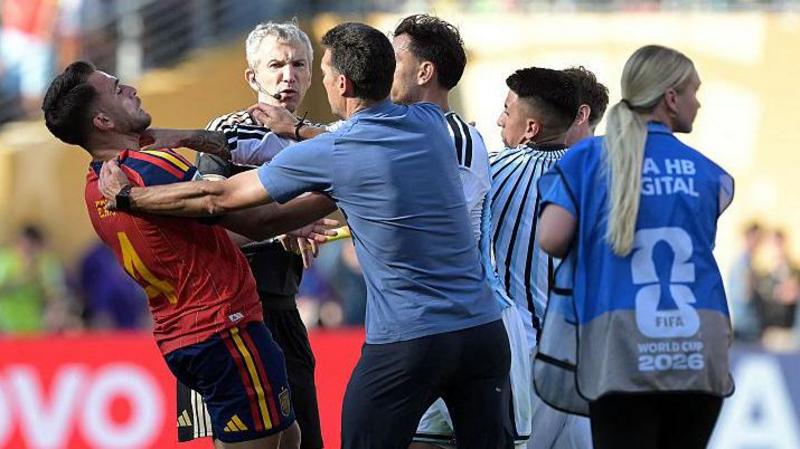
After the 1-0 defeat on Sunday, members of the Argentina team and backroom staff were involved in altercations with Spain players as they began to celebrate their World Cup success.Any player or coach involved in the fracas at the MetLife Stadium could face suspensions, while the Argentine Football Association (AFA) may also be fined.It was initially reported by Fifa that Argentina's Leandro Paredes had been sent off by referee Slavko Vincic after he pushed Spain's Eric Garcia by the throat.Paredes' red card was removed from the record shortly afterwards and there is now no evidence of any disciplinary action being taken at the time.Argentina had already had one player dismissed, with Enzo Fernandez receiving a second yellow card in second-half stoppage time.Fifa's disciplinary committee will now await the official match reports before taking any action.As the final whistle blew in New Jersey, a few Argentina players - including Lionel Messi - slumped to the turf.Others stood there motionless as Spain's players raced across the pitch in jubilation.Rodri, who had been substituted in extra-time, ran over from the dugout to join his team-mates.As the Manchester City midfielder went past Nahuel Molina, the Argentina defender appeared to punch Rodri on the arm or stomach.This was the fuse which ignited the trouble.Rodri confronted Molina, but it was the Argentina player who thrust forward in an aggressive manner.Garcia ran over to back up his team-mate at which point Paredes got involved too, jabbing Garcia in the throat.Unused substitute Gavi tried to intervene, only to be forced to the ground by Thiago Almada.Paredes then pushed Gavi to the floor by putting his hand in the Spaniard's face.Argentina assistant coach Roberto Ayala then looked to be holding Garcia around the throat. He then appeared to strike Spain midfielder Dani Olmo."Paredes threw two or three haymakers into someone's face. He went for them," Alan Shearer said on BBC One's coverage. "There is no place or space for that."We know how much it means to them and we know how much it hurts to lose, but there is a way to lose. Too many times we have seen that from Argentina. The reaction after the final whistle is terrible."Joe Hart added: "The game's done, they can have absolutely no complaints about what happened today. Disgusting behaviour."But Argentina boss Lionel Scaloni, who had attempted to calm down the situation, appeared to play down the incidents in his post-match interview."We are gracious in victory, and we must be gracious in defeat," he said. "Today, we are showing that we know how to lose."We lost the match, and we accept it, but that doesn't mean we stop living or forget everything we did to get here."Fifa's disciplinary committee has a number of options open to it.It could look to issue three-match bans for violent conduct, but it is more likely to use its disciplinary code to give stronger charges.Article 13 covers offensive behaviour and the principles of fair play.The actions of the players and staff could be judged as "violating the basic rules of decent conduct" and "behaving in a way that brings the sport of football and/or Fifa into disrepute".The Fifa disciplinary committee takes into account "both aggravating and mitigating circumstances", and it has the power to enforce the ban globally.Rubiales was banned from all football-related activities for three years in 2023 and lost an appeal to get it overturned.Uruguay striker Luis Suarez was suspended from all football-related activity for four months for biting Italy defender Giorgio Chiellini at the 2014 World Cup.It meant the Liverpool player missed the first nine games of the Premier League season.It is unlikely that Paredes, Molina and Ayala will face bans as long as this.The AFA, however, has faced issues with the behaviour of its players in recent years.Argentina faced charges related to "offensive behaviour and violations of the principles of fair play" and "misconduct of players and officials" following the 2022 World Cup final.The South Americans beat France on penalties but were criticised for the way they celebrated.Aston Villa goalkeeper Emiliano Martinez made a lewd gesture with his Goalkeeper of the Tournament trophy, before being filmed in the dressing room mocking France star Kylian Mbappe.Argentina were fined Β£18,300 and no action was taken against any player involved.But Martinez was banned for two games in 2024 for 'offensive behaviour' in World Cup qualifiers against Chile and Colombia.Martinez repeated his infamous celebration using a replica Copa America trophy following a 3-0 win over Chile. Four days later, he hit a camera with his gloves as a cameraman approached him on the pitch after a 2-1 defeat by Colombia.At this World Cup, the AFA is already facing a probable fine for the banner held up after the England game.Their players celebrated while holding a cloth which read "Las Malvinas son Argentinas", which translates as "The Falklands are Argentine".In 2014, the AFA was fined Β£20,000 after its players held up a banner with the same message before a friendly against Slovenia.It is possible that Fifa could issue bans to the players who were holding it: Tottenham's Cristian Romero, former Spurs player Giovani Lo Celso and Manchester United's Lisandro MartΓ­nez.After Spain's 2-1 Euro 2024 final win over England, their captain Alvaro Morata and team-mate Rodri were banned for one game by Uefa after they chanted "Gibraltar is Spanish" during their victory celebrations.So when could Fifa make a decision on any potential charges?After the 2022 World Cup final on 18 December, Fifa officially charged Argentina on 13 January but it took another month for a decision to be reached.There will not be a resolution any time soon.Could Infantino really push through a 64-team World Cup?Victory for football? Spain beat Argentina to win World CupSixteen titles in five years - why Spain are a dominant forceHow to watch the World Cup on the BBC and ITV

BBC SportMon, 20 Jul 2026
Source: BBC Sport
Read story
'I'm proud of it' - Keegan looks back on career highlights and legacy

Football News

'I'm proud of it' - Keegan looks back on career highlights and legacy

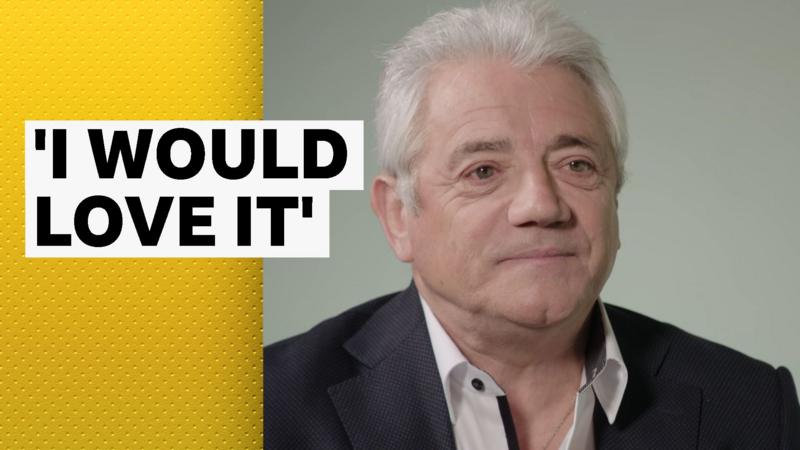
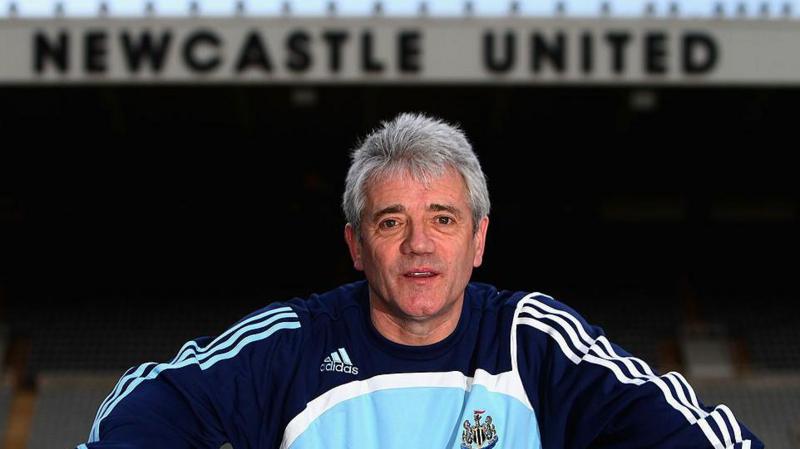
Close261Kevin Keegan talks to Football Focus' Dan Walker in 2018 about some of the standout moments from his career - from winning World Player of the Year twice, to managing England and the iconic "I would love it" remark from the 1995–96 season.Shareclose panelShare pageCopy linkAbout sharingRelated topicsLiverpoolFollow Liverpoolclose panelYou are now following LiverpoolUpdates from your Sport topics will appear in My Sport and in a collection on the Sport homepage.England Men's Football TeamFollow England Men's Football Teamclose panelYou are now following England Men's Football TeamUpdates from your Sport topics will appear in My Sport and in a collection on the Sport homepage.Newcastle UnitedFollow Newcastle Unitedclose panelYou are now following Newcastle UnitedUpdates from your Sport topics will appear in My Sport and in a collection on the Sport homepage.FootballFollow Football

BBC SportMon, 20 Jul 2026
Source: BBC Sport
Read story
Hearts agree deal to sign Forest Green captain Mendy

Football News

Hearts agree deal to sign Forest Green captain Mendy

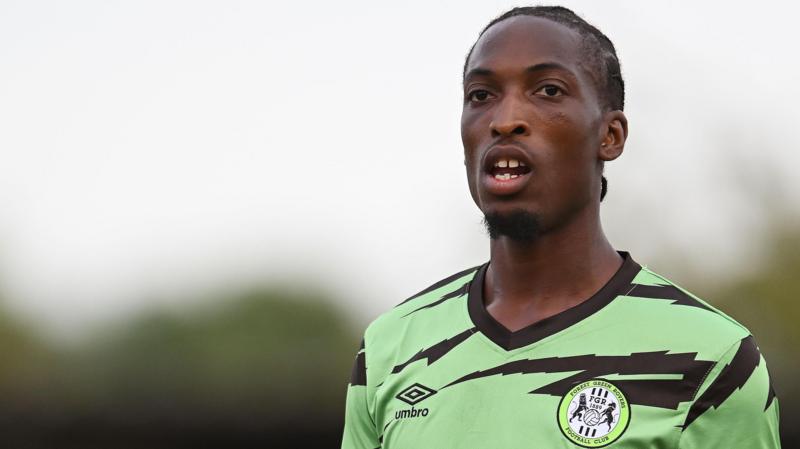
Hearts have agreed a deal to sign Forest Green Rovers captain Laurent Mendy.The midfielder has been on the Tynecastle side's wanted list for the past two transfer windows, with the club having had a bid turned down in January.However, a deal has now finally been struck for the 29-year-old French-born player, who is set to become Hearts' 10th summer signing.Mendy joined Forest Green in 2025 from Macclesfield and played 47 games last season for the English National League side.Talks regarding personal terms are now under way as Hearts prepare for the first leg of their Champions League second-round qualifier against Sturm Graz on Tuesday (19:30 BST).Visit our Hearts page for all the latest news, analysis and fan views

BBC SportMon, 20 Jul 2026
Source: BBC Sport
Read story
Was Rodri really the player of the tournament?

Football News

Was Rodri really the player of the tournament?

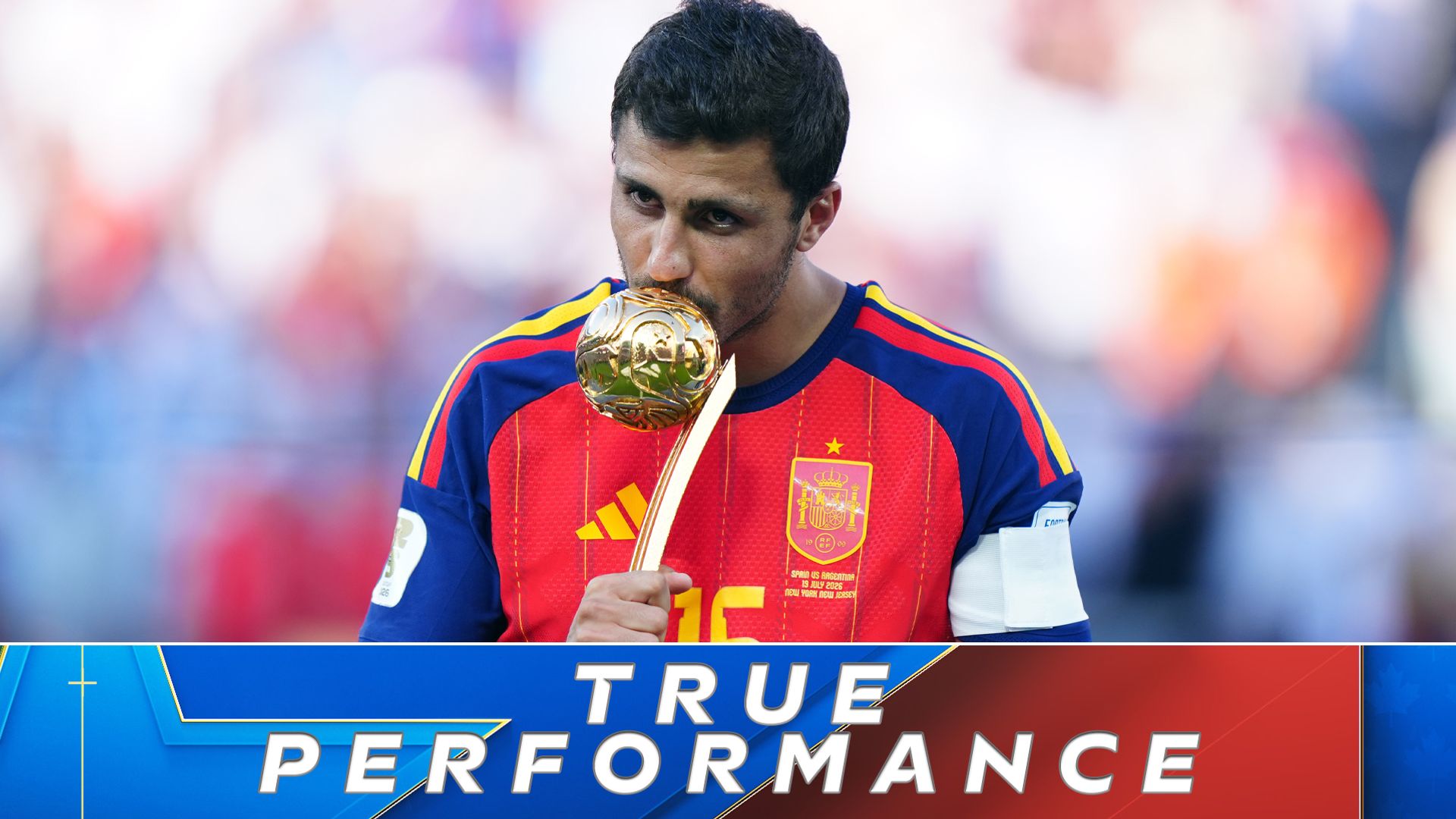
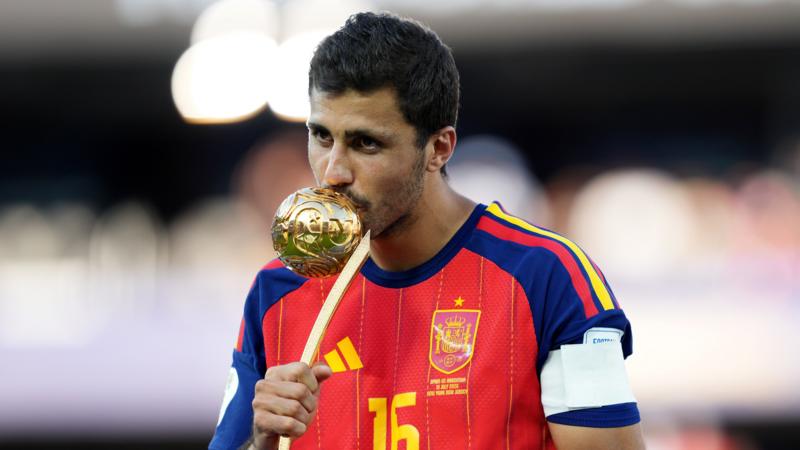
It feels like 2024 all over again. Spain dominate all the way to glory, and Rodri is the on-field mastermind credited by overseeing it all.The Manchester City midfielder led his side to their second World Cup, just two years after being the man behind their European Championship glory.Like then, his individual efforts were recognised as he was named the recipient of the World Cup Golden Ball for the best player of the tournament. His compatriots Pau Cubarsi and Unai Simon were also among the award winners, claiming the Young Player and Golden Glove awards respectively.Rodri pipped the likes of Lionel Messi, Kylian Mbappe and Jude Bellingham to the main award, all of whom had stellar tournaments. Due to the understated nature with which Rodri tends to go about his business, him coming out on top has created a heated debate akin to when he won the Ballon d'Or in 2024.Do those other superstars really have a right to feel hard done by?Well, Sky Sports' Power Rankings do have the trio of Messi, Mbappe and Bellingham as the top three performers of the 2026 World Cup, in that order. Where does Rodri rank on that list? 18th.True Performance is Sky Sports’ unique way of measuring a player's performance during each game of the 2026 World Cup. Using Sky Sports’ Power Ranking system, more than 40 key pieces of data will be analysed to reflect how well a player has performed in their position and give them a rating out of 100. The higher the rating, the better the player performed and once the benchmark of 100 is set, it is harder to reach.In fact, according to his overall tournament rating, he was only the seventh-best Spanish player at the World Cup.So, why was he named player of the tournament? Well, no one was more involved on the ball than Rodri. He topped the charts for touches, but that means little. What matters is what he did with them.At both ends of the pitch, he was heavily involved. In attack, he ranked second for final third passes and 15th in chances created. Defensively, he made the most tackles in the tournament and also ranked in the top four for possessions won in the attacking and middle thirds.What the data can't account for is his experience. The impact his leadership has on a young team is crucial.That's the pros, but what about the cons? Those have less to do with his performances and more to do with the strength of others. Across 43 key stats analysed, Rodri finishes in the top 10 of 13 of them. That's better than Bellingham [12]; however Messi and Mbappe have 18 top 10 finishes apiece.It can also be noted that Messi had the best individual performance of the tournament according to the rankings - his hat-trick hero display in Argentina's opener vs Algeria.These include goals, assists, big chances created and through balls. Of course, they aren't as strong in the defensive statistics, but the power rankings acknowledge the stats most relevant to their positions.The data shows that while Rodri was undoubtedly a top performer, he didn't excel to the same extent as Messi and Mbappe. And given the fact they were all important leaders, Rodri's captaincy isn't enough to give him the edge. The argument can certainly be made that the best team were awarded the best player award, rather than the actual best player.Before the tournament, Lamine Yamal would've been most people's pick for the Young Player of the Tournament. Instead, it was his Barcelona team-mate Cubarsi who stole the show.It is clear to see why the 19-year-old was named the golden boy of the tournament. As part of a defence that conceded just one goal all tournament, Cubarsi shone. No player aged 21 or under played more passes, made more clearances or won possession back in all thirds. He even ranked in the top four in final third passes. This is a defender, bear in mind.Meanwhile, Lamine Yamal didn't quite hit the heights expected of him. Though he did still star in certain areas compared to other youngsters, his stats are swallowed up when you compare them with players of all ages. Cubarsi remains elite.The other Spaniard to pick up an individual accolade was goalkeeper Simon. Having been preferred throughout the tournament to Arsenal's David Raya, Luis de la Fuente's selection paid off. With seven clean sheets in eight games, it's hard to argue against him.His ranking inside the top five of the power rankings is heavily influenced by his clean sheets, something he definitely deserves credit for. However, he wasn't the busiest of goalkeepers. In fact, the Athletic Bilbao man made just 10 saves all tournament. Emi Martinez, on the other hand, made 20.However, only Vozinha outperformed his xG conceded [1.98] by a greater margin than Simon [1.7]. And the moment when the Spaniard rushed off his line to stop Messi running through on goal in the early stages of the final epitomised another strength of his game.No goalkeeper completed more sweeper regains all tournament [11], while his final passing accuracy of 77.87 per cent was only bettered by six others. All in all, the ideal competition for a modern-day goalkeeper, who just so happened to have an incredible defence ahead of him to boot.We put it to you in our World Cup blog on if you thought Rodri deserved to win the World Cup Golden Ball in our dedicated World Cup blog, and this is what you had to say:Red Rob: Rodri was awesome in every game. 100 per cent back to his best. Messi was a bit-part player, only came out to play for 10mins most games. I love watching him but final was a game too far.MH92: If the best player award is based on performances, so many players had better games than Messi, Bellingham for example. If it's based on goal involvements, Mbappe should win it with a new record 14. Rodri deserved it, Messi, didn't.RJ1878: Argentina never reach the final of the World Cup without the things Messi has done in this tournament. At 39, people said he couldn't do it again but he's dragged that team to another final. And the numbers back it up too!Ryan: Can't believe Rodri was given player of the tournament! His side won the World Cup but he wasn't the best player of the tournament, should've been Bellingham.Gaz: Messi wasn't really in the top 5 if we're being honest. He scored a few goals but he doesn't do much. Plays in moments.Vaughn: No, Messi shouldn't have gotten it. Throughout the World Cup arrogant and wanted everything to go his way. Rodri probably was the right person to win it, I'd say followed by Bellingham then Mbappe.

Sky SportsMon, 20 Jul 2026
Source: Sky Sports
Read story
Rodri's stock at all-time high as he adds to trophy collection

Football News

Rodri's stock at all-time high as he adds to trophy collection

3 CommentsAs Spain captain Rodri lifted the World Cup trophy high into the New Jersey sky, he added another trophy to his already glittering record.A Ballon d'Or, one European title, one Nations League, four Premier League trophies, one Champions League and numerous other domestic triumphs. And now the greatest prize of them all.The Manchester City playmaker has long been revered for his club exploits, but now his stock is at an all-time high as he added world champion to his list of accolades when Spain beat Argentina 1-0 in the World Cup final on Sunday in New Jersey.Not only did the Spain captain steer his side to a first triumph since 2010 and stitch a second star on the national shirt, but he was also crowned player of the tournament.The 30-year-old becomes only the fourth men's player to win the World Cup, Euros, Champions League and Ballon d'Or, joining legends Gerd Muller, Franz Beckenbauer and Zinedine Zidane.But until recently, this level of success perhaps seemed out of reach for Rodri.After rupturing his anterior cruciate ligament in 2024, questions were asked about whether he could ever really return to the heights that saw him clinch the Treble with City in 2023 and claim the Euros with Spain a year later.Such a major injury takes time to recover from and it is only in glimpses during last season that we saw the Rodri of old.Now it seems the Spaniard was simply biding his time, patiently waiting for a full return to fitness in order to peak at the World Cup in the United States, Canada and Mexico.Rodri's future in Manchester remains uncertain with only one year left on his contract and Real Madrid reportedly coming knocking.It begs the question what next for Spain's conductor?If 19-year-old Lamine Yamal is the flair and creativity of the Spanish team, Rodri is the puppet master.His role in the middle of the park may often go under the radar, but he is the one stringing it all together.Throughout Spain's World Cup campaign he completed 756 passes, the most in a single edition on record since 1966.He featured in all eight of La Roja's matches en route to glory, topping the metrics for touches (910), passes in the opposition half (428), line-breaking passes (122) - including in the final third (76).There are only three instances on record (since 1966) of a player completing 100+ passes in a World Cup final. Brazil's Dunga in 1994 (130), defender Pau Cubarsi (121) and Rodri (101) - both in this year's edition."Rodri was absolutely outstanding," said Spanish football journalist Guillem Balague."He is not only the guy who ran the longest in the whole tournament and average per game, the amount of passes he gives to beat defenders, he is at his sharpest, he is at Ballon d'or level. This is Rodri's team."A second Ballon d'Or does not seem out of reach, although he has perhaps not played enough club football to make him the favourite for the individual accolade in a stacked field.Rodri is currently being linked with a move to Real Madrid, where returning manager Jose Mourinho is reportedly very keen on the composure, defensive ability and ball control of the former Atletico and Villarreal midfielder.New City boss Enzo Maresca is unlikely to be interested in letting Rodri go but, with only one year left on his contract, there is naturally a degree of uncertainty about the situation.One thing is for sure, his performance at this World Cup has placed him as a hot property - one that City would surely not want to part with but would also fetch a premium price if they did.Returning from an ACL injury is a notoriously difficult task.Having suffered the injury in September 2024, mere months after Spain's Euros triumph, Rodri missed the rest of that season then featured sporadically last campaign.He made 33 appearances across all competitions for City but suffered a number of injury setbacks and, at times, looked a shadow of the player he was before the injury.Former City boss Pep Guardiola predicted in October last year that we would not see the best of Rodri until the World Cup.And, as has so often been the case, the Catalan was right."I've gone through a logical process that every football player has to go through after an injury like this," Rodri said after Spain's triumph."It takes a year to get back to your best fitness level and then one more on top of that to feel like yourself again as the player you were."You need to be patient, and you need to believe and be confident in yourself."It was a frank conversation with Guardiola, where Rodri told him he needed to stop to get his body right for the World Cup, that changed the trajectory of his recovery and ensured he was back to his best for the summer tournament."To get where I am today in my current form, I had to be clever," Rodri added."I had to know when to stop playing and when to carry on when I needed to, and that's part of what you need to do to recover properly."It's been a very tough time. I just want the new generations to see my example as an opportunity."When you go down, you can rise again. This is my philosophy for my entire life."Of course, sometimes things go well, things go wrong, but always the positiveness."Best goal, best player, best fans - BBC reporters' World Cup awardsVictory for football? Spain beat Argentina to win World Cup

BBC SportMon, 20 Jul 2026
Source: BBC Sport
Read story
After this World Cup, here’s what I feel: a kind of messy hope | Jonathan Liew

Football News

After this World Cup, here’s what I feel: a kind of messy hope | Jonathan Liew

Kazakhs cheering Uzbeks, Bengalis wild for Argentina … This tournament was once a playground for nationalism. Now it shows how flimsy that allegiance isIt’s the World Cup final, so you pick a side. And don’t worry if you happen to be part of the 98.9% of the human race that is neither Spanish nor Argentinian – just make something up. Maybe you like the Spain kit. Maybe you’ve always been an admirer of Lionel Messi. Maybe you’re still raw about the Falklands or Diego Maradona, maybe you disagree with the Pedro SΓ‘nchez government’s stance on Palestine/Israel, maybe you once ate a dodgy empanada on your gap year. Nobody needs to see your working. Only two rules really apply: be partisan and be quick about it.The MetLife Stadium on Sunday night was a melting pot of colliding incongruities and temporary identities. The former heavyweight boxing champion Mike Tyson was wearing an Argentina shirt. The comedian Trevor Noah wore a Spain shirt. Indeed, ticket sales data suggests that an overwhelming proportion of the crowd was American. The most consequential fixture in international sport was, as it turned out, little more than a grand cosplay for the New Jersey leisure market.And beyond the final, perhaps this has been one of the hidden stories of the World Cup: the gradual reimagining of national allegiance as a kind of single-use consumer brand. For six weeks, the entire nation of Bangladesh went crazy for Argentina. A group of central Asian friends in north London put aside their internecine rivalries to cheer for Uzbekistan. The Arab diaspora swung firmly behind Morocco and Egypt as the tournament progressed. Leftwing progressives who revile the cross of St George when painted on a mini-roundabout were suddenly daubing it on their cheeks.All of which upends what we have been told for decades about the World Cup, and international sport in general. A tournament that should in theory be the ultimate playground for nationalism has in fact demonstrated the very opposite: the increasing fragility of nationhood as an idea. What the social psychologist Michael Billig termed banal nationalism – the subliminal everyday symbols of nationhood – has now become so banal as to be in essence disposable. If national identity is now something that can be slipped on and off as easily as a football shirt, then what use is it, really?We live in an age where the boundaries of nationhood are both ever-more piercingly evoked and ever-more hazily defined. Again, football illustrates this confusion better than almost any other human endeavour. Across western Europe, far-right voices preach the doctrine of nationalism while reviling their own national teams for having too many black players. In Colombia and Brazil, many leftwing fans have chosen to spurn the national team shirt as a result of its appropriation by rightwing populists.This is before we even address the teams themselves: in many cases not so much cogent expressions of national identity or even recognisable products of a system as they are snapshots of a sprawling diaspora at a particular moment in time, splintered on multiple planes by globalisation and migration, assembled out of convenience and expediency. Forty of the 48 competing nations contained a player born overseas. Only one member of the CuraΓ§ao squad was actually born on the Caribbean island. The Cape Verde squad that held the eventual champions, Spain, to a heroic 0-0 draw in the group phase featured more players born in Rotterdam than in the country’s capital.And so the modern World Cup serves two abrupt functions. First, it forces us to confront the idea that most of us have multiple identities cutting across or even against national boundaries, that everywhere is the product of everywhere. Second, it interrogates the criteria by which we pledge allegiance to a country, a process that most of the time lies latent and unspoken, only bursting to the surface in the form of an urgent binary question: β€œWho do I support for this game?” The historian Eric Hobsbawm’s famous quote about football gestating an β€œimagined community of millions” takes on a subtly different resonance when you realise that very often this is a community with no defined borders or polity, a community that for 90 minutes draws its number from every corner of the planet.Weirdly, this is a phenomenon that has become neither exclusively left- nor right-coded. If nationalism was long regarded as the preserve of the populist right and internationalism as the preserve of the intellectual left, these days the picture is far more nuanced. Today’s rightwing agitators are as likely to pledge allegiance to Donald Trump or wave an Israeli flag as they are to champion the country they’re actually from. The Trump administration has consistently demonstrated greater solidarity with white South Africans than with Black Americans. Across the English-speaking world, conservative outlets freely make alliances across national borders and appeal to abstract concepts such as β€œJudeo-Christian values” or β€œwestern civilisation” while denouncing and dehumanising many of their fellow citizens as traitors and scum.Football’s role as a nation builder is often overstated. France’s World Cup triumph in 1998 was hailed as a vindication of the country’s multiethnic identity, but four years later it sent Jean-Marie Le Pen into the final round of the presidential election. Argentina’s 1978 victory on home soil generated a surge of popularity for the country’s military dictatorship, but by 1983 it had collapsed. England’s run to the European Championship final in 2021 did not, for all the good vibes and open letters, arrest our wider descent into gutter politics and culture war.But occasionally it can hold up a mirror. And perhaps what this World Cup reflects back at us is a kind of messy hope: that a world of hardening physical borders is doomed to disintegrate on contact with reality. That for all the flags and pageantry, nationality is ultimately little more than a brand, a consumer choice, a piece of content – a mask anyone can happily wear for six weeks, and shed just as easily.

Jonathan LiewMon, 20 Jul 2026
Source: The Guardian
Read story
A pioneer and a superstar, Kevin Keegan’s achievements were extraordinary

Football News

A pioneer and a superstar, Kevin Keegan’s achievements were extraordinary

The former England manager may be remembered by many for his β€˜I’d love it’ rant in 1996, but that should not obscure the remarkable nature of his football careerKevin Keegan, who has died aged 75, is the only British player to win the Ballon d’Or twice, was the star of Liverpool’s first European Cup-winning team, a messianic figure at Newcastle United as a player and coach, forging a team so memorable that Fifa’s president wrote to commend him, and was the captain and then manager of the England men’s national team. And yet, as Keegan would ruefully reflect, he will principally be remembered by many for an emotional outburst that precipitated Newcastle’s historic failure in a Premier League title race, a TV interview which presaged the coming era of the modern game.Keegan’s β€œI’d love it” rant of April 1996, directed at Alex Ferguson, became a meme before the modern meaning of the word and social media even existed, repeatedly played on Sky Sports and becoming indelibly marked in the minds of multiple generations, many not even born when it occurred. It frequently tops polls as the most memorable moment in Premier League history and foreshadowed an era where digital clips and personality narratives would dominate football coverage.There is a danger, however, of reducing Keegan’s life to a series of ever-more emotional explosions, of which there were many, such as his punch-up with Leeds United’s Billy Bremner in the 1974 Charity Shield. For that would obscure the extraordinary nature of his achievements and the fact he was arguably the most charismatic modern English footballer; more eloquent than David Beckham and Paul Gascoigne and more passionate than Bobby Moore. He had a rare gift for inspiring players and almost everyone who interacted with him at his best came away uplifted.Still, Keegan’s meltdown on TV, where he took issue with Ferguson’s supposed β€œmind games” in suggesting Leeds players would go easy on Newcastle during a tight title run-in with Manchester United, became a defining moment. β€œStrangers shout β€˜love it’ to me from car windows,” wrote Keegan in his autobiography. β€œAutograph hunters tell me they would β€˜love it’ if I could sign their pieces of paper. When I go to charity events I am often asked to sign photographs showing me in that classic pose: headphones on, finger jabbing, blazing eyes. Those pictures tend to be auctioned for a lot more money than the ones where I am playing for England or any of my clubs.”Keegan claimed to be relaxed about the characterisation, skewed though it was, perhaps because more than any English footballer before he had maximised football’s commercial and media opportunities and accepted the respective bouquets and brickbats that ensued. Even before that meltdown, he would be best remembered by many in the 1970s for his excruciating bike crash on Superstars, a TV show which pitted athletes from different sports against each other in unfamiliar disciplines. Sprawled across the cycle track, Keegan’s bare flesh was ripped red raw by the gravel. Most remember the drama but few recall that, showing characteristic pig-headed determination, he got back on the bike, bloodied and bandaged, for a rematch, which he won before winning the entire contest.Keegan was born in Armthorpe, Doncaster, to Doris and Joe, a war veteran Durham miner who had migrated south in search of work at Markham colliery. His upbringing echoed Monty Python’s Yorkshiremen sketch, only his memories were authentic, a throwback to a different century. Their terrace house β€œhad a detached outhouse where we washed. Our bath was an old zinc tub and the toilet was at the foot of the garden and we never had electricity until I was 10 and we moved into a council house in Balby.”Keegan’s ascent to the peak of the game’s elite was unforeseen, few recognising his talent early on, most dismissing him as too small. He always credited Sister Mary Oliver, the nun who ran his Catholic primary school football team and who refereed with a crucifix around her neck, as being as important to him as a mentor as Bill Shankly was. β€œKevin’s football must be encouraged,” she wrote in a school report, which gave him immense self-belief.Doncaster Rovers rejected him and he started work at Peglers Brass Works at 16, playing for their football team but only in the reserves and also for a pub team on Sundays, where he fortuitously played against a Scunthorpe scout, Bob Nellis, who got him a trial at the struggling Third Division club. Keegan referred to himself as a β€œmongrel” and β€œweasel” and the β€œleast-talented” Ballon d’Or winner, and despite impressing at Scunthorpe it was still a major shock when Shankly, the man he regarded as a second father and progenitor of his success, took him to Liverpool. Shankly told him: β€œYou’re not just a great player – you’re one of the great players!” It seemed an unlikely boast but Keegan scored on his Liverpool debut and was never dropped thereafter. He would inherit from Shankly comparable motivational skills.Though reclusive, Keegan also had a streak of extrovertism, embracing every aspect of the game’s growing commercial opportunities, from his famous Brut advert to appearances on Top of the Pops, where his single Head Over Heels in Love reached the top 40. Though he enjoyed standing out, he admitted he would never have got away with his trademark bubble perm in the old-school Liverpool dressing room. His wife, Jean, whom he met on the waltzers at the Doncaster St Leger horse racing meeting when she was 16 and he was 19 and to whom he remained married for life, burst into fits of laughter when she first saw it. He had the last laugh, the hairstyle inspiring alarming copycat versions across the football world.Keegan remained true to what he considered to be his working-class, mining roots, declaring himself a Labour man, annoyed that a staged photo of him feigning to kiss then prime minister Margaret Thatcher on the cheek was interpreted as support for economic policies which had ravaged heavy industry. He was more at home playing head tennis with a later PM, Tony Blair, to whom he was close enough to host at his home for dinner.Keegan inherited two mantles from Britain’s greatest players of the 1960s. As George Best, the original footballer sex symbol of the modern era, lapsed into alcoholism and increasing unreliability, Keegan became the more wholesome and dependable commercial face of the superstar footballer in Britain, inundated with deals. For England he effectively became Moore’s successor as captain but at a time when the national team was in decline from his predecessor’s World Cup-winning heights. For Keegan, as the sole outfield world-class player, it was a heavy burden to bear as they missed out on successive World Cup finals.His first major tournament for his country was the ill-fated 1980 European Championship and his World Cup career amounted to 20 minutes in 1982, a campaign which was disrupted by a back injury and where β€œmy only contribution was a dreadful miss against the host nation to send us home. That moment is probably the only moment of my England career that people remember now.” It would prove to be his last game for England at the age of just 31.Keegan was a pioneering player, negotiating release clauses, unheard of at the time in England, at Liverpool and Hamburg, allowing him to leave if a club met a Β£500,000 fee, thereby controlling his moves. Leaving Liverpool at what was assumed to be their peak – he had just helped them win their first European Cup in 1977 – to join a team sixth in the Bundesliga was demonstrative of both Keegan’s single-mindedness and capacity to challenge himself. He also quadrupled his salary, reflecting the economic state of English football at the time.Hamburg was not an initial success. Jealous teammates held meetings to get him kicked out of the club and, according to Keegan, refused to pass to him. His nadir came at Christmas 1977 when, in a festive-season friendly, unhappy at his plight and frustrated with over-physical treatment from the LΓΌbeck defender Erhard Press, Keegan punched him on the jaw and subsequently knocked him out, receiving an eight-week ban as punishment. Yet, a year later, he won his first Ballon d’Or and went on to lead Hamburg to their first Bundesliga title since 1960.Keegan embraced Germany, learning the language and was nicknamed β€œMighty Mouse”, a tribute to his astonishing strength given his diminutive size. His first daughter, Laura, was born there but his finale, a European Cup final that would have sealed Hamburg’s place in history, was a sad one, ending as it did in defeat to Nottingham Forest. Having won three league titles, two Uefa Cups, an FA Cup and European Cup at Liverpool, the Bundesliga title would be the last trophy Keegan ever won. He was just 29 years old.Keegan made a typically unconventional choice in joining Southampton, a promising yet small-market team under a talented, persuasive manager in Lawrie McMenemy. Keegan propelled them to a top-six finish and qualification for Europe, but they faded to seventh in the second season and Keegan, disillusioned, made a decision that would define the second half of his professional life.Newcastle were in one of their periodic financial and footballing crises and in the old Second Division when, with money from brewers Scottish & Newcastle, they persuaded him to join in 1982. His father’s links to the north-east and reverence for Newcastle players such as Jackie Milburn were an emotional pull on Keegan, but one that cost him his England career. The manager, Bobby Robson, didn’t feel it appropriate to pick a second-tier player for England and Keegan, still captain and by far the most iconic national team player, learned from the press he had been β€œdumped”. He felt β€œbetrayed, hurt and humiliated”.Crowds doubled at St James’ Park with Keegan’s arrival and Newcastle were promoted as champions in Keegan’s second season, 1983-84, by which point he had already decided to quit playing at the age of 33. Typically impulsive, it was when Mark Lawrenson outsprinted Keegan to dispossess him during an FA Cup tie at Liverpool that he decided he would finish his career at the end of the season.Keegan and family, which now included his second daughter, Sarah, born in 1982, decamped to his Marbella villa and, other than periodic business deals and discussions about a long-held dream to launch a Soccer Circus, he embraced retirement. Yet endless rounds of golf failed to satisfy. The family had moved back to his Hampshire home when Sir John Hall, a dynamic north-east businessman, called in 1992, begging Keegan to help Newcastle avoid relegation to the third tier and potential liquidation. Despite having watched no football for years, Keegan accepted. He threatened to quit after a few games but stayed to keep Newcastle up and promptly announced that he wanted to build a dynasty to rival Liverpool and challenge for the Premier League title.Most considered that quixotic and yet Newcastle won promotion to the Premier League as champions and with judicious youthful signings such as Andy Cole and Rob Lee, and veteran players such as Peter Beardsley, they came third and sixth in the top flight. So great was his authority, Keegan could even placate angry fans on the steps of St James’ Park when the club sold Cole to Manchester United.With that money the club signed David Ginola and Les Ferdinand and won nine of their first 10 games in 1995-96, often in thrilling fashion, establishing a seemingly unassailable 12-point lead by January. But a crucial defeat at home to Ferguson’s United in March 1996 and the Scot’s repeated use of psychological barbs seemed to weigh heavy on Keegan as his team’s form disintegrated. A dramatic yet debilitating 4-3 defeat at Liverpool led Sepp Blatter to write to Keegan but the sight of him slumped over advertising hoardings as Liverpool scored a last-minute winner suggested the toll was too much.Keegan eventually cracked, denouncing Ferguson in his famous TV interview. β€œYou can tell him now, we’re still fighting for this title and I’ll tell you, honestly, I will love it if we beat them. Love it!” United won the title with four points to spare.Keegan initially seemed determined to rebuild as the club signed Alan Shearer for a world-record Β£15m and they beat United 5-0 at St James’ Park that autumn, but Keegan quit soon after, outraged that a city banker preparing the club for flotation had issued him an ultimatum to sign a contract. Football’s new era seemed untethered from the idealistic foundational values imbued in him by Shankly.Keegan seemed done with football until the now-disgraced Harrods owner Mohamed Al Fayed used speculative talks about his much-vaunted Soccer Circus to persuade him to become chief operating officer and eventually manager of Fulham in the third tier. He almost seemed at his happiest as the club accelerated to promotion, but his time was interrupted by a national crisis when Glenn Hoddle was sacked as England manager for making offensive comments about disabled people. The clamour for Keegan to take over was indicative of his popularity with ordinary fans. However, it proved a decision he came to greatly regret, taking in a humiliating Euro 2000 group-stage exit and ending with him resigning in the toilets after an ignominious defeat against Germany in England’s last game at the old Wembley Stadium. It was, he conceded, a job beyond his abilities.That said, Keegan was happy to take on Manchester City in the old First Division, getting them promoted to the Premier League as champions with 99 points. He remained at the club for four years, an almost unprecedented period of stability at the club at that time. When he finally left City he seemed to be done with coaching and finally launched his Soccer Circus in Glasgow, though it closed after a few years. Yet there was to be one last comeback at Newcastle under the ill-starred ownership of Mike Ashley, which proved a disaster and lasted just eight months.The idea that a high-minded, old-fashioned football manager schooled by Shankly could coexist with a modern businessman as ruthless as Ashley and his cast of minions running the club always seemed improbable. When he walked away from the job, eventually winning a lengthy and bitter constructive dismissal claim, it was to be Keegan’s last act in football. So acrimonious was the departure that he was only able to return in disguise to attend a function at the club.The current regime made clear Keegan was always welcome back at St James’ Park. That was after his stage four cancer had been revealed in a series of speaking engagements in May 2026, one of which in Newcastle was, in retrospect, a heartfelt farewell to the fans to whom he had always felt closest. After that draining but exhilarating evening Keegan’s associates reported that he was in high spirits, energised by the reconnection with the fans who loved him most.It was to prove Keegan’s final goodbye. Football, as he observed, had given him everything except for a happy ending.

Rob DraperMon, 20 Jul 2026
Source: The Guardian

Read story
Gifted, charismatic and passionate amid highs and lows - Keegan obituary

Football News

Gifted, charismatic and passionate amid highs and lows - Keegan obituary

Chief football writerPublished19 minutes agoKevin Keegan, who has died aged 75, was one of football's most charismatic and influential figures in a career of many chapters that took him from superstar player to elite manager.While some may remember him best for his ill-fated reign as England manager, he will rightly be much more celebrated as a world-class player at Liverpool and Hamburg, captaining England, and shining latterly at Southampton and Newcastle United, before becoming arguably the most beloved figure in the Tyneside club's history.Keegan revived Newcastle's fortunes as a player before carrying the Geordie nation with him on a thrilling ride as manager, first by taking the club back into the top flight, then delivering a magnificently entertaining team that challenged for the highest honours - even if they ultimately fell short.His time at Newcastle will also be recalled for his infamous "I will love it if we beat them" TV outburst aimed at Manchester United boss Sir Alex Ferguson as Newcastle's 12-point lead in the 1995-96 title race evaporated - but the unconditional love the Geordies felt for Keegan was never diluted.Keegan's career was a reflection of himself.He was hugely gifted, honest, decent, hard-working and emotional. There were highs and lows, but the positivity and vibrancy he brought made him a cherished figure.Born in Armthorpe near Doncaster, Keegan came to Liverpool manager Bill Shankly's attention when playing more than 100 games for Scunthorpe United, sitting on a bin outside Anfield while the Iron's legendary Scottish boss Ron Ashman finalised one of the all-time great bargains as the 20-year-old was transferred for Β£35,000 in 1971.Keegan was regarded by some observers as simply a hard-working player who made himself great through sheer grit and determination. The initial assertion was correct, but he was much more than that.Shankly, not one to knowingly undersell his players, told Keegan within a fortnight of arriving at Liverpool that he would play for England.The new signing scored on his Liverpool debut on the opening day of the 1971-72 season against Nottingham Forest at Anfield, a scruffy finish set up by John Toshack. It was the start of a beautiful football relationship with Liverpool as well as with the Welshman.Their almost telepathic partnership - a classic "big man, little man" combination - was even put to the test on television.They gelled to such an extent that Granada TV's groundbreaking Friday magazine show Kick Off had Keegan and Toshack sitting back to back, trying to guess the colour and shape of a card the other was holding.Such was their success rate some thought telepathy actually was at work - but the pair later revealed there was a mirror in the studio and they could see the other's cards.Keegan was the spearhead of Shankly's second great side, in total winning three league titles, the European Cup, FA Cup and the Uefa Cup twice under his Scottish mentor and then his successor Bob Paisley.He was instrumental in all of those triumphs, scoring twice in the 3-0 victory against Newcastle in the 1974 FA Cup final. His first prompted the famous line from BBC commentator David Coleman: "Goals pay the rent - and Keegan does his share."In the subsequent Charity Shield against league champions Leeds United, Keegan was sent off after a flare-up with Billy Bremner, who was also dismissed, with both leaving the Wembley pitch shirtless. Johnny Giles had been the instigator, landing a blatant right hook on the Liverpool player, but was not sent off.In the 1972-73 Uefa Cup final against Borussia Monchengladbach, Keegan scored twice in the first leg at Anfield, a game played at the second attempt after a thunderstorm 24 hours earlier caused the match to be abandoned after 27 minutes.The rearrangement allowed Shankly to recall Toshack, who had been left out of the initial match, and he and Keegan tormented the Germans in a 3-0 victory, Liverpool subsequently winning 3-2 on aggregate.When the trophy was won once more against Club Brugge three years later, this time under Paisley, Keegan scored a vital goal in Belgium, the second leg finishing 1-1 to ensure a 4-3 aggregate victory.Even off the field, Keegan's competitive spirit burned, taking part in BBC TV's Superstars series in 1976, which allowed athletes from different sports to compete against each other.Keegan, however, suffered elbow and shoulder injuries when he fell off his bicycle. It was a rare fall from grace.He also tried his hand - or voice - in the music business, releasing a single in 1972 titled It Ain't Easy.Ever ambitious and eager to test new horizons, Keegan announced midway through the 1976-77 season that he would leave Liverpool at the end of the campaign.It brought some criticism from supporters, but was another example of deception never being part of Keegan's character, allowing Liverpool time to line up Kenny Dalglish as his replacement.He went out on the highest high in his final game, running the great German defender Berti Vogts ragged as Liverpool won the European Cup for the first time, beating Borussia Monchengladbach 3-1 in Rome.Keegan left having scored 100 goals in 323 appearances.There was talk of a move to Real Madrid, but in the end his destination was Hamburg, where he was a major success as they won the Bundesliga in 1978-79, though disappointment followed when they lost the European Cup final to Nottingham Forest the following season.Keegan confirmed his world-class credentials at Hamburg, winning the Ballon d'Or in 1978 and 1979.Hamburg was a surprise choice when Keegan left Liverpool, but after early struggles to win over team-mates, he became hugely popular, not just with his club but in the country, where they appreciated the Englishman's down to earth approach and his willingness to integrate.It all added to Keegan's status as a global superstar, one of the most marketable sportsmen around, not just seen on the pitch but in adverts and advertising hoardings worldwide.He famously did an advert for Brut aftershave with British boxer Henry Cooper, as well as the "Green Cross Code" road safety campaign.While in West Germany, Keegan had another crack at music with the track Head Over Heels In Love. It peaked at number 31 in the UK, but climbed to number 10 in the German charts.Keegan returned to England in 1980 with a shock move to Southampton, showing his enduring quality by winning the Professional Footballers' Association player of the year award in 1982.He did not win trophies at The Dell, but was still a player of the highest class in Lawrie McMenemy's team, built around experienced stars such as Keegan, Alan Ball and Saints' great Mike Channon.Keegan won 63 England caps over a period lasting almost a decade, scoring 21 goals and captaining the side 31 times.It was a slow burner after making his debut in a World Cup qualifier in Wales, even including a physical assault by security men at Belgrade airport in summer 1974 when England arrived for a friendly against Yugoslavia under caretaker boss Joe Mercer.There was horseplay at the luggage carousel, resulting in the perfectly innocent Keegan, one of the highest-profile players in the squad, being taken away to a side room, where he was punched and kicked. He was released, going on to score a late equaliser in a 2-2 draw.Keegan briefly walked out of the England squad after being dropped for a home international against Wales in 1975, but returned after talks with manager Don Revie.It summed up an England career that never fulfilled its potential.England failed to qualify for the 1974 and 1978 World Cups, then when Keegan captained England at the 1980 European Championship in Italy, they did not progress from the group stage.He was captain again at the World Cup in Spain two years later, but a chronic back injury - for which he left the camp to seek treatment from a specialist in Germany - meant he did not play until the last 26 minutes of England's second-round game against Spain.Keegan uncharacteristically missed a simple headed chance, the game ending goalless to send manager Ron Greenwood's side home.He was left out of Greenwood's successor Bobby Robson's next squad, and never played for England again.Keegan felt Southampton, even under the shrewd management of Lawrie McMenemy, did not match his ambition so he signed for Newcastle - then in the old Division Two - for Β£100,000 just before the start of the 1982-83 season.It was the start of a love affair when Keegan scored on his debut against Queens Park Rangers.Newcastle were promoted to the top flight in 1983-84, but Keegan announced he would retire at the end of that season, a decision prompted by getting caught by Liverpool defender Mark Lawrenson when clean through in an FA Cup third-round tie at Anfield which his old club won 4-0.In typical Keegan fashion, he felt he had lost a vital yard of pace so it was time to go, leaving St James' Park after a final game, his testimonial against Liverpool, still dressed in his Newcastle kit while he was whisked away by helicopter.Keegan moved to Spain with his family vowing never to enter management, but on 5 February 1992, almost eight years after his final game as a player, Keegan returned to Tyneside.Keegan's management trademark was all-out, thrilling attack, with his former Liverpool and Newcastle team-mate Terry McDermott at his side and charismatic chairman Sir John Hall shaping the off-field strategy.He had initial differences with Hall over transfer cash, prompting another classic Keegan quote when he said: "It's not like the brochure."Matters were quickly resolved and soon Newcastle were on their way.Having saved Newcastle from relegation to the third tier, Keegan inspired them to promotion to the Premier League, finishing only behind champions Manchester United and Blackburn Rovers in 1993-94 with goals and creativity provided by strikers Andy Cole and the returning Peter Beardsley.Cole was sold to Manchester United in a surprise move in January 1995, Keegan famously standing on the steps outside St James' Park to explain the decision to unhappy fans.The peak of Keegan's reign, along with the biggest disappointment, came in 1995-96 when Newcastle, strengthened by the addition of high-class stars such as Les Ferdinand and David Ginola, moved 12 points clear in the title race, only to squander the advantage to Manchester United.There were two enduring images of Keegan as glory escaped his grasp, head bowed as Liverpool scored in stoppage time to win 4-3 in an all-time Premier League classic in April - before that tirade aimed at Ferguson.Ferguson questioned whether Leeds and Nottingham Forest would try as hard against Newcastle as they would against Manchester United - and after a win at Elland Road, Keegan exploded.His broadside ended with the never-to-be-forgotten quote: "I will love it if we beat them. Love it."Some felt Keegan's time at Newcastle never recovered from that crushing blow, but his charisma and the call of home helped England's top marksman Alan Shearer reject Manchester United to make a world record Β£15m move from Blackburn that summer.Shearer's debut ended in a 4-0 loss in the Charity Shield to the club he turned down, revenge exacted spectacularly with a 5-0 win at home in the Premier League two months later.Keegan then stunned Tyneside on 8 January 1997 by resigning, saying in a short statement: "I feel I have taken the club as far as I can."He returned to the game the following September as Fulham's chief operating officer, eventually taking over as manager and leading the Cottagers' journey back to the First Division.Keegan was appointed England's caretaker manager for a four-game period after Glenn Hoddle was sacked in February 1999.He initially insisted he did not want the job and would return to Fulham, but the warm reception he received when England beat Poland 3-1 at Wembley in his first game pulled on his emotions.However, by his own admission, Keegan proved an ill fit for the greater tactical nuances of international management, publicly admitting: "If it's a 0-0 draw in the Ukraine you want, then I'm probably not your man."England qualified for Euro 2000 with a two-legged play-off victory against Scotland, but the campaign was a dismal failure.Keegan's side were beaten 3-2 by Portugal in their first game after leading 2-0 inside 17 minutes. Germany were beaten by a single Shearer goal, but a calamitous 3-2 loss to Romania, having led 2-1, sent England out.Keegan carried on, but criticism was mounting against this passionate, yet sensitive man.He resigned in dramatic fashion in October after England lost their opening World Cup qualifier to Germany in the final game played at the old Wembley Stadium before it was demolished and rebuilt.The conversation, in which he told then Football Association executive director David Davies he was going, took place in a Wembley toilet, with a rain-soaked Keegan then going on television to admit: "I just don't feel I can find that little bit extra you need at this level to find a winning formula."It was the most brutal recognition of his own shortcomings.Keegan could not resist the lure of the game, however, succeeding Joe Royle as Manchester City manager after relegation from the Premier League in May 2001.His commitment to exciting attacking football remained, signing entertainers such as Eyal Berkovic and Ali Benarbia. City were promoted as First Division champions after scoring 108 league goals.Adding quality like France striker Nicolas Anelka, City finished ninth in the Premier League, Keegan also inspiring more remarkable memories.In an FA Cup fourth-round replay at Tottenham in February 2004, City came from 3-0 down at the interval, with midfielder Joey Barton sent off at the end of the first half, to win 4-3 through Jon Macken's late winner. A month later they handed out a 4-1 beating to Manchester United.While Keegan had indicated his intention to retire at the end of the 2004-05 season, he instead left by mutual consent in March 2005.Tyneside was overcome with joy and excitement when Newcastle United owner Mike Ashley announced Keegan's return as manager in January 2008.It was an ill-starred pairing, Keegan resigning after only eight months following differences with Ashley and Newcastle's hierarchy, including his former England player Dennis Wise, who was executive director.Keegan was unhappy at his lack of control, saying: "I've been working desperately hard to find a way forward with the directors, but sadly that has not proved possible."It's my opinion that a manager must have the right to manage and that clubs should not impose upon any manager any player that he does not want."He added: "I have been left with no other choice than to leave", and later won damages from the club for constructive dismissal.It was his final farewell to football, but he remained beloved by the 'Toon Army', as well as at Anfield, his standing as a person and respect for his work in football illustrated by the outpouring of affection and goodwill when he released news of his illness.

BBC SportMon, 20 Jul 2026
Source: BBC Sport
Read story
What does Rogers' move mean for Chelsea's squad?

Football News

What does Rogers' move mean for Chelsea's squad?

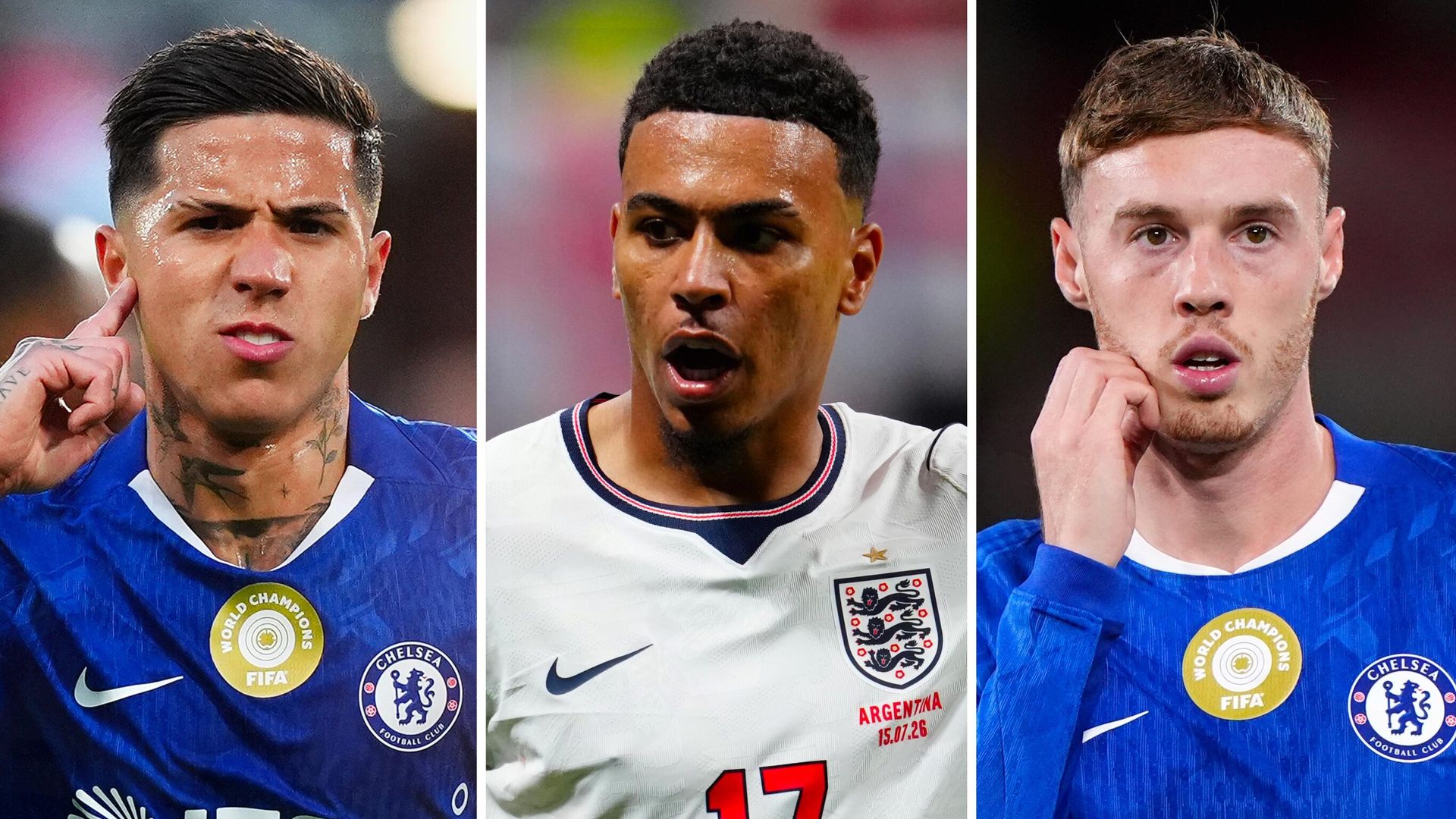
Morgan Rogers is set to join Chelsea in a British-record Β£117m from Aston Villa - and his arrival is set to have a knock-on effect for Xabi Alonso's Blues.The England international - who arrived for his medical on Monday after returning from the World Cup - had also been linked with Arsenal, but he is set to arrive in the west of London instead.Here, Sky Sports News reporters Kaveh Solhekol and James Savundra examine why Rogers is keen on the move and what the forward's imminent arrival could mean for the rest of the Chelsea squad.KS: Some people may be surprised that Rogers has decided to swap Aston Villa for Chelsea, but the player really did have his heart set on moving to Stamford Bridge and once the bid materialised, he accepted it straight away.Playing for Chelsea next season means he will not be playing in Europe. If he had stayed at Aston Villa, he would have been playing in the Champions League, but Chelsea are still a big club.They have big ambitions and under their new manager Alonso, they are very serious about challenging for the big trophies again.Rogers is obviously a fantastic player, we've all seen that, but he is also very physically imposing. There's been a feeling at Chelsea that one thing their side has been missing is some real physical presence and they've been trying to address that this summer. They've gone some way towards it by signing a player like Rogers.Stream the Premier League with no contractKS: I remember being at the game between Aston Villa and Chelsea last season and that was billed as being a game between Cole Palmer and Rogers - who was the better No 10? I think on the day, Aston Villa ended up winning that game and Rogers played really well.So you have to ask the question - will Chelsea be able to have both Rogers and Palmer in the same side? The two players know each other well. They were together at Manchester City and Palmer's famous 'cold' goal celebration was first invented by Rogers. It'll be up to Alonso to see how he can accommodate both those players in the same side.There are no indications that Chelsea want to sell Palmer, far from it. He's tied down to a very long contract and just before the end of the season, he gave a newspaper interview in which he said he was happy at Chelsea and was happy living in London.There have been reports seeming to suggest that he may want to move back to the north west, that one day he wants to play for Manchester United, but I think he would cost so much that there are not many clubs who would be able to buy Palmer if Chelsea wanted to sell him.KS: Enzo Fernandez has come out on a few occasions and made it clear that he fancies a move to Real Madrid, but we had some sort of clarity on that a couple of weeks ago when the LaLiga club released a statement saying that they were not involved in any negotiations.They had not made a move to sign Fernandez and if they did want to sign him, then they would do everything through the proper channels. Real Madrid have a very good relationship at the highest level with Chelsea, so I'm sure if they were interested in signing Fernandez, it would simply be a matter of picking up the phone.I think what Chelsea would tell them is every player has his price and Fernandez's price is £120m. If you want him, that is what it's going to take to buy him. But as of yet, Real Madrid have not made a move for him to our understanding.JS: Fernandez's position remains largely unchanged despite the arrival of Rogers. Alonso confirmed his intention to keep the Argentine at his unveiling last week and noted to Sky Sports News that he was looking forward to working with the midfielder.Having committed more than £100m to buy Fernandez in 2023, Chelsea would be looking to recoup at least a similar level of money to sanction a sale.Real Madrid have ruled themselves out of the running to signing Fernandez - for now - which leaves few viable suitors.The Argentine enjoyed success under Enzo Maresca, but is a move to Man City likely in a window in which City have spent £116m already on Elliot Anderson and given the tension between the clubs given the Maresca saga?JS: Alonso refused to give any clues last week when it came to his playing system. His main success as a manager at Bayer Leverkusen saw Jeremie Frimpong and Alex Grimaldo dominate as wing-backs. If he adopts his preferred formation at Chelsea, Rogers is most likely to operate as a wide attacking midfielder.Given the struggles of Alejandro Garnacho and Jamie Gittens last season and the presence of Palmer, you would expect Rogers to be favoured on the left.There are real similarities between the positions picked up by Palmer, Rogers and to some extent Joao Pedro. Whilst the trio thrive in fluid positions rather than a strictly fixed structure, Alonso will need to lay out a clear framework with specific roles.JS: Chelsea are Club World Cup champions. They have not always been world class on the pitch during the BlueCo era but they have been world-class sellers.They have already ensured enough outgoings this summer to cover the £117m cost of Rogers. Chelsea raised around £130m from selling players like Marc Cucurella, Andrey Santos and Tyrique George and the sizeable compensation from Man City for poaching Maresca certainly helped too.The likes of Reece James, Palmer and Joao Pedro are seen as untouchable assets, but other members of the first team squad will depart for sizeable fees - Garnacho, Nicolas Jackson and Trevoh Chalobah are likely to bring in another £100m if they go.Despite not being in Europe this season, Chelsea will still be subjected to UEFA's stricter financial rules. Last summer, Chelsea entered into a four year settlement agreement with UEFA for breaching regulations and they'll look to demonstrate progress in showcasing financial sustainability following this window.Chelsea brought in around £300m from player sales last summer and given the need to move on a number of defenders who are surplus to requirements and at least one striker, it could be another impressive summer of trading.KS: It's a long transfer window… but I'm not sure Arsenal would have been prepared to pay £117m for him.Perhaps you could argue that Chelsea need him more at the moment - Arsenal are the reigning champions and they are in the Champions League as well.A lot of these deals only happen when somebody puts their money where their mouth is. We can talk about the fact that Arsenal were potentially interested in Rogers, but it's Chelsea who made a bid and that has been accepted by Aston Villa.

Sky SportsMon, 20 Jul 2026
Source: Sky Sports
Read story
How has the World Cup impacted the Ballon d'Or race?

Football News

How has the World Cup impacted the Ballon d'Or race?

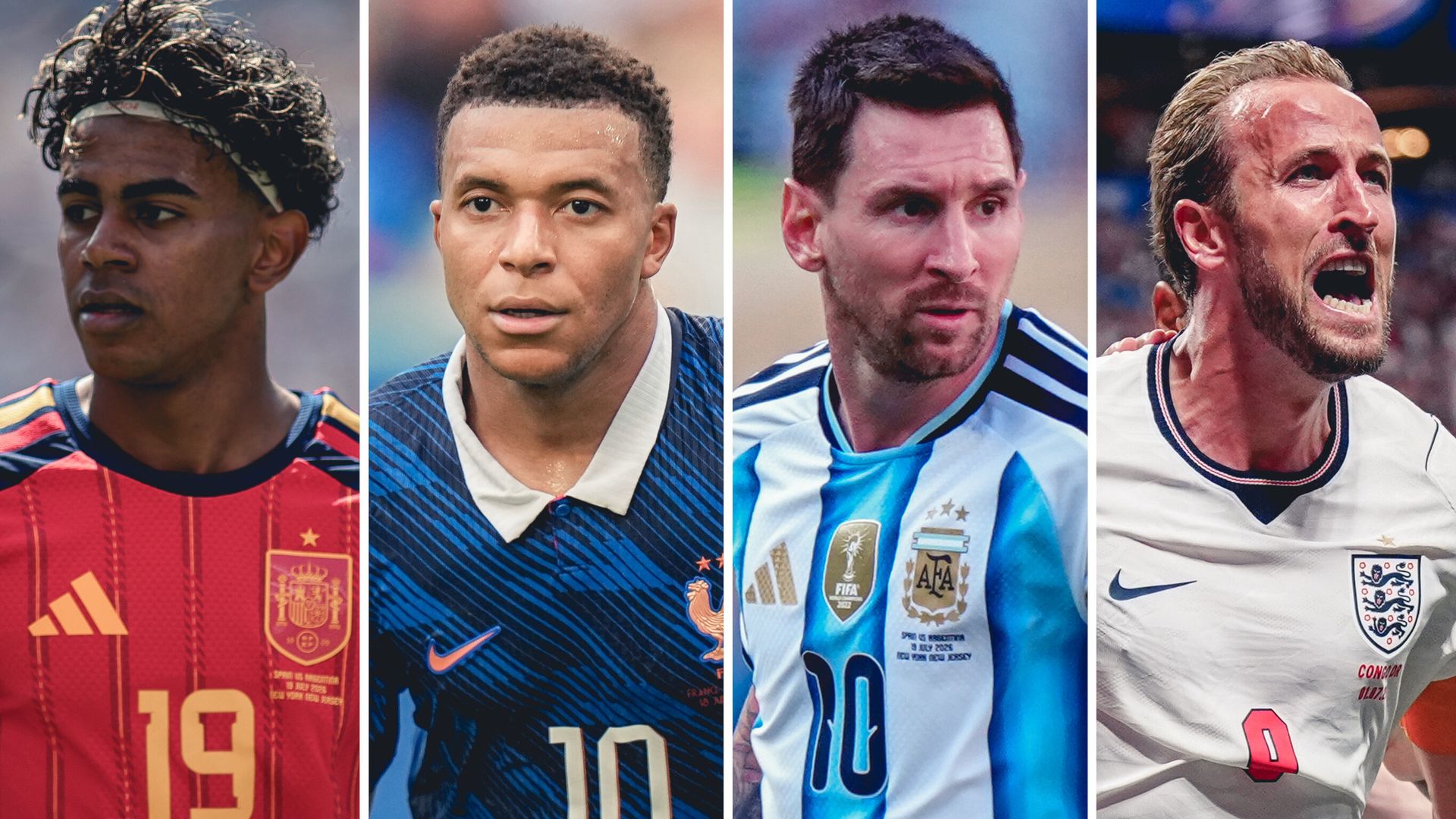
The biggest individual prize in football has many variables. Often the Ballon d'Or race is dictated by those players who have spearheaded their club sides, or national teams, to trophies.Ousmane Dembele got his hands on last year's prize after leading PSG to their first Champions League title.This year is different, though. The World Cup holds influence and power unlike any club competition is able to. It sways opinion with a greater degree of certainty. And this, a World Cup of superstars, served up plenty of compelling cases.So, who put their best feet forward and whose argument was damaged over the course of a long, hot summer for most of the world's best?Harry Kane lifted more silverware at club level this year, his 61 goals in 51 outings proving unstoppable as Bayern Munich romped to a domestic double. Such form had England fans dizzy with hope and expectation.But as England's bid tapered off earlier than pre-tournament possibilities suggested, so too did Kane's ability to rise above in the crucial moments. Of course England's failure to pick off a beatable Argentina team was not solely Kane's fault. Thomas Tuchel hardly helped his captain's cause.But the 32-year-old's individual performance dropped in England's final two outings, eclipsed by a rousing Jude Bellingham. Kane ended the tournament with six goals but could not steer his side to the final. That is the only reward he believes really matters in the end.Given Kane's career-best club pursuits, this summer is perhaps best categorised by disappointment over the No 9's world-class talent, left without a World Cup final stage to showcase it. Nevertheless, he remains among the favourites for the second-best scoring season by any player since the turn of the millennium (73 goals).Barcelona's teen sensation is another frontrunner. Lamine Yamal became the first player to have played in both a Euros final and a World Cup showpiece before the age of 20 on Sunday. He won both.His influence this summer was more understated than pre-tournament hype suggested, just one goal, but he still made a considerable contribution. Twelve straight major tournament wins in succession.The penalty he won against France in the semi-final was game-changing. His unique manipulation of the ball in the final tournament-defining. As England found out the hard way, breaking lines against Argentina's tough tacklers is not easy. He was the one who made it possible for Spain, finishing the tournament with more successful take-ons than Lionel Messi.Delivering 28 goal involvements as Barcelona won LaLiga will do his chances no harm, either. If not this year, his time will come soon enough.Messi is the most successful player in Ballon d'Or history after claiming the prize a remarkable seven times. His performances this summer put him in line for an extraordinary eighth.Despite being beaten to the Golden Boot by Kylian Mbappe - rather farcically, given two of the Frenchman's goals were scored in a dead rubber third-place play-off - Messi moved and mesmerised as if in his peak 20s in a summer when celebrated his 39th birthday.In terms of numbers, his World Cup has been an exceptional triumph. His hat-trick in Argentina's opening game against Algeria set the tone. He scored in the next four games, too, before playing a fundamental part in England's semi-final fall.Only four of the past 19 Ballon d'Or wins have gone to a player who did not claim a Champions League, World Cup, Euros or Copa America title in the same year. Three of those were Messi. Perhaps one last celebration of his greatness is the best way to indulge all that he has offered the beautiful game. A peerless pioneer.Kylian Mbappe is the first player to win the World Cup Golden Boot twice. The France captain deserves huge credit for that, and should of course be celebrated for becoming the World Cup's all-time leading scorer, too.But, often, individuality without silverware is not what draws the top prize. As Mbappe himself acknowledged: "I would have preferred not to be the top scorer and to have played in the final". Those kinds of records only really look good alongside a winner's medal to validate the contribution.Given Real Madrid also endured a trophylesss campaign, Mbappe's wait for a Ballon d'Or might yet go on. His elite scoring ability will no doubt ensure he stays in contention for many years to come, though.2024's Ballon d'Or winner, a non-runner before this summer, has suddenly emerged as a contender. With sound reason.Rodri's club campaign may have been stop-start because of needing to manage minutes after the ACL injury that ruled him out of the majority of the season prior, but he has risen to prominence once again for Spain over the past six weeks. He is the immoveable object.Only four different men's players have won the World Cup, Euros, Champions League and Ballon d'Or. He is one of them; drawing comparisons with Spain greats for his controlling influence. A tournament defined by Spain's supreme authority.Rodri made 122 line-breaking passes in his eight appearances, the most since Xabi Alonso in 2010, on his way to winning the Golden Ball. Numbers even Xavi and Andres Iniesta would be proud of.The 70th edition of the prestigious award ceremony will take place on October 26, in London. 2025's top winners include Aitana Bonmati of Barcelona and Ousmane Dembele of PSG.

Sky SportsMon, 20 Jul 2026
Source: Sky Sports
Read story
Former England forward and manager Keegan dies aged 75

Football News

Former England forward and manager Keegan dies aged 75

It was announced in January that the former England player and manager had been diagnosed with stage four cancer, with his family revealing he was set to begin treatment."It is with immense sadness that we announce that Kevin Keegan has passed away at the age of 75," a statement from Keegan's family read."The former England player and manager had been battling cancer and was surrounded by his wife and daughters in his final moments."Kevin, a double Ballon D'or winner, was a much loved husband, father and grandfather. The family would like to thank Kevin's incredible medical team for all their support. This is a hugely difficult time and they are requesting space and privacy."Keegan was considered one of the best players of his generation and enjoyed a stellar playing career, making almost 750 club appearances, lifting the First Division trophy three times with Liverpool and winning the Ballon d'Or back-to-back in 1978 and 1979 while playing for Hamburg in the Bundesliga.Seven years after his retirement, he took his first coaching role as manager of a struggling Newcastle team in February 1992. The Magpies were in danger of being relegated to Division Two but Keegan kept them up and then led them to the Premier League in his first full season in charge. Then, in 1996, he took Newcastle to within touching distance of their first top-tier title since 1927.Newcastle were Premier League title favourites for most of that 1995/96 season, at one stage being 12 points clear of Manchester United. But a dramatic collapse from Keegan's side coupled with a Sir Alex Ferguson-inspired Man Utd winning 13 of their last 15, eventually saw Newcastle finish second by four points.Late defeats at the hands of Liverpool and Nottingham Forest in the run-in saw United eventually haul them in. As the pressure mounted on a beleaguered Keegan, who was desperate to deliver the title to a passionate Newcastle fanbase, his infamous "I'd love it.." post-match interview after victory at Leeds, aimed at Sir Alex, among others, unfortunately characterised his time at St James' Park.He would go on to manage England, for whom he had scored 21 goals in 63 games as a player, between February 1999 and October 2000 - resigning minutes after a 1-0 defeat to Germany in the last game played at the old Wembley Stadium.His time as national boss also saw England fail to get out of the group stage at Euro 2000, despite a 1-0 win over Germany, as defeats by Portugal and Romania piled on the pressure even before that defeat at the hands of Dietmar Hamann's free-kick four months later in the first qualifier for the 2002 World Cup.A spell at Manchester City followed, which included promotion to the Premier League in 2002 as Division One champions, but Keegan left the club in March 2005, initially announcing his retirement from football.Keegan made an emotional return to Newcastle in 2008, but only lasted eight months following tensions with the board and owner Mike Ashley."We are devastated to learn of the passing of Kevin Keegan, one of the most iconic, influential and deeply-loved figures in our club's history."Kevin was more than a legendary footballer and manager. He was the beating heart of Newcastle United for generations of supporters."As a player, he brought world-class talent, ambition and belief to St. James' Park, helping to transform perceptions of what Newcastle United could be."As a manager, he ignited our city. Kevin gave supporters hope and pride, and led a team whose style, spirit and passion captured the imagination of football fans around the world. He was so much more than an Entertainer."Above all that, Kevin forged an extraordinary bond with Newcastle, built on the roots of his father, Joe. He understood our people. He embraced the North East with a passion that was genuine and unwavering, and in return, he earned his rightful place in the hearts of millions."Kevin's impact will not be measured by appearances or results. It will live on in the memories he created with club and country, the dreams he inspired wherever he went, and the generations of supporters around the world who fell in love with football because of him."At this profoundly sad time, we send our love and deepest sympathy to Kevin's wife Jean, his family, friends and all who had the privilege of knowing and working alongside him."Today, we mourn the loss of a true giant of our history, and at the appropriate moment, we will carefully consider how we shape a lasting tribute to Kevin's remarkable life and legacy. Rest in Peace, King Kev."Southampton FC: "We are devastated to learn of the passing of Kevin Keegan. Kevin signed for the club in 1980 as the holder of the Ballon d'Or and brought great joy to fans at The Dell and across the football world. Our thoughts are with his family and friends at this difficult time."

Sky SportsMon, 20 Jul 2026
Source: Sky Sports
Read story
What will Rogers bring to Alonso's Chelsea?

Football News

What will Rogers bring to Alonso's Chelsea?

On Monday, Rogers returned from the United States, having featured for England at the World Cup, to undergo a medical in London and sign a six-year contract with an option for a further year.It had been widely expected that Rogers, who was Villa's most prized asset, would be available only for an English transfer record fee, but many expected Arsenal to be the frontrunners.However, Chelsea had been tracking Rogers for more than two years and had quietly made him their top attacking target. They moved quickly after England's semi-final defeat by Argentina out of his desire to focus on the World Cup.On Thursday, after the 2-1 loss, a combined effort involving the club's sporting directors, head coach Xabi Alonso and co-owner Behdad Eghbali helped secure a deal. Even Chelsea captain Reece James was making the club's case from within the England camp, while those close to the negotiations say Cole Palmer was also aware of developments as, in Rogers' words, "one of my best friends in life".It was a well-planned operation involving figures across the club and resulted in Rogers being signed in under 48 hours.The deal was underpinned by the strong relationship between Chelsea co-owner Eghbali and Aston Villa owner Nassef Sawiris, with the agreement being finalised on Saturday afternoon, shortly before Rogers took to the field in England's bronze-medal victory over France.After the deal was agreed, Arsenal were offered the chance to match the bid but they informed Villa they were committed to their lower valuation and were willing to let him join Chelsea on those terms.They will now consider alternative targets, including Paris St-Germain's Bradley Barcola and Bournemouth's Junior Kroupi.Although Chelsea had tracked Rogers for more than two years, the clubs had previously discussed a potential deal during the 'Profit and Sustainability swaps' of 2024.One option explored was Nicolas Jackson reuniting with his former Villarreal manager Unai Emery, before Ian Maatsen moved to Villa Park and Omari Kellyman joined Chelsea.Yet Chelsea's move also represents a recalibration of their transfer tactics.In April and his last interview, Eghbali accepted Chelsea needed "to add more ready-made players at this part of the project, to take (it) to the next level, to be consistent over time," adding: "You tweak a model, you improve, you learn from mistakes."Palmer first performed his 'cold' celebration in December 2023 after scoring two goals in a 3-2 win at Luton.He has since taken ownership of the celebration, literally, registering a trademark for it with the UK Intellectual Property Office after scoring two goals against Luton.However, it was first meant as a tribute to Rogers as he performed the celebration after a goal for Middlesbrough against West Brom.It was after moving from his local club West Brom to Manchester City that Rogers first struck up a friendship with Palmer. Both were 16 and soon starred in attack for City's FA Youth Cup-winning under-18 side in 2020.Joining Chelsea should ease Rogers' transition. He already knows Levi Colwill and Reece James through the England set-up, while Tosin Adarabioyo, Jamie Gittens, Romeo Lavia and Liam Delap all came through City's academy system.That English contingent forms a substantial part of the club's leadership group, alongside Enzo Fernandez and Moises Caicedo.There is, however, the more important issue of football and where Rogers fits into the team, especially given Palmer is a similar type of player.Rogers was among the players selected by England manager Thomas Tuchel ahead of Palmer for this summer's World Cup, but their versatility means they can play either together or in each other's position.One source suggests Rogers will primarily play on the left, with Palmer operating centrally as a number 10. That would leave Estevao Willian, Pedro Neto and new signing Geovany Quenda competing for places on the right and Jamie Gittens as his understudy.Chelsea are likely to use a back four at times next season, but they are also exploring a back-three system, which Alonso used to devastating effect when winning the Bundesliga with Bayer Leverkusen in 2024.That could allow Palmer and Rogers to play together as dual number 10s, while wingers would be asked to operate in deeper wing-back roles. The Spaniard is considering several tactical options before the start of the season.Chelsea had a number of problems last season, one of which was a five-game goalless run under former head coach Liam Rosenior, which led to his sacking.Rogers contributed 14 goals and 12 assists in 55 appearances last season and would add further firepower.Looking at the wider squad, and assuming winger Alejandro Garnacho is sold as planned, Chelsea would currently have six attackers competing for three forward positions in a season without European football. In addition, they have five senior strikers - Joao Pedro, Nicolas Jackson, Liam Delap, Emmanuel Emegha and Marc Guiu - on the books.It is clear that the squad needs trimming after last season's 10th-place finish, particularly given Chelsea can play a maximum of 51 matches if they reach both domestic cup finals.It's not just about keeping players happy - Chelsea must also sell players to keep the books balanced.The Β£117m fee represents a substantial outlay on top of the Β£47m spent to sign full-back Marco Palestra from Atalanta, as well as the potential arrivals of defenders Pep Chavarria from Rayo Vallecano and Maxence Lacroix from Crystal Palace.In addition, midfielder Valentin Barco is expected to join from Strasbourg, though Chelsea have yet to confirm the deal.It took a league-record Β£300m in player sales last season for Chelsea to comply with the Premier League's financial rules, which are due to move from a Financial Fair Play-based system to a squad cost ratio model this summer.Uefa, however, represents the biggest obstacle to Chelsea's continued spending after fining the club Β£26.7m for breaching its rules last summer, while Villa were also fined and are under the same scrutiny, which led to Rogers' sale.Chelsea were again found to have breached European football's governing body's regulations this summer, but the financial picture improved significantly, resulting in a fine of just Β£2.6m. Most of that amount will be waived if the club continues to improve its finances.With five new signings expected this summer, Chelsea will want to sell or loan out at least a dozen players from the 37 senior options on their books, and for as much money as possible, to keep their accounts healthy.They have already sold Marc Cucurella to Real Madrid, Andrey Santos to Manchester United, Tyrique George to Everton and Jimmy-Jay Morgan to West Bromwich Albion for a combined fee of more than Β£120m.Generating transfer income has become increasingly important for Chelsea, who lag behind their traditional big-six rivals in commercial and matchday revenue, while also falling behind in broadcast income after missing out on Champions League football in three of the past four seasons.Latest Chelsea news, analysis and fan viewsAsk about Chelsea - what do you want to know?

BBC SportMon, 20 Jul 2026
Source: BBC Sport
Read story