Football News
Introducing football to the country with one pitch
Introducing football to the country with one pitch
Like everywhere, the world's smallest island nation has been gripped by football fever for the past six weeks. But once Spain lifted the World Cup trophy on Sunday, almost every trace of football on Nauru stopped.
While there is interest in big Premier League matches, and children wear Lionel Messi and Cristiano Ronaldo kits, any attempts to actually play football tend to be mocked, unless it's Aussie rules.
But things may be slowly changing as a group of volunteers - led by British former academy player Charlie Pomroy - seek to introduce the game to what was once the world's richest nation per capita but is now heavily reliant on foreign aid and has one of the highest obesity rates in the world.
A social media post from the Nauru Soccer Federation congratulating the new world champions and setting out a dream that "one day we hope to be in Spain's position" may have been fanciful, but the groundwork is real in what it says is the last country not to have had a senior international side.
Laying the foundations, though, on an island where over-mining has left the landscape looking more like a moonscape, has been far from straightforward.
Nauru has tried to develop football previously, but it has never really taken off. The closest it has come to playing an international match was when representative teams faced a Solomon Islands expatriate team in 1994 and a refugee side in 2014.
Its complicated past goes some way to explaining why the world's most popular sport has struggled for participation.
Located in the Pacific Ocean 2,500 miles north east of Australia, Nauru's historical wealth was built on its vast deposits of phosphate from fossilised bird poo.
Nauru, which was a dependent territory of Australia until independence in 1968, was heavily mined in the late 20th Century. The minerals dried up, leaving the country once named Pleasant Island looking ragged, with large parts of its central areas uninhabitable and extremely challenging to farm.
This resulted in most of the 12,000-strong population clustering around the coastal edges with usable space at a premium on an island that measures only 21 square kilometres. And even that is shrinking, with climate change and rising sea levels threatening its very existence.
Its barren land has left the country importing more than 90% of its food – much of which is processed, contributing to 69% of the population being classed as obese and around 40% having type 2 diabetes.
One of its main sources of revenue now is from the Australian immigration detention centre it has housed for much of this century.
Everyday life on the island can be a struggle and sport has been a strong release for many, but the sport of choice is Aussie rules, which 30% of locals play. Also popular are athletics and weightlifting, which Nauru has competed in at the Olympics.
Nauru will host the Micronesian Games in 2028 – a multi-sport event that includes football and will showcase the island's desire to grow its international reputation through sport.
"They are trying to change the image for the better and get involved in more sport," says Pomroy, technical director for Nauru Soccer and one of eight volunteers aiming to develop football on the island.
"They [Nauru] want people to see the country in a more positive light rather than the punchline of a joke.
"So whether it's football, whether it's Aussie rules, whether it's rugby, basketball, cricket, weightlifting... just to be part of building a healthier Nauru is enough.
"But being a football lover, the best way I know how to have an impact is through football."
And the Briton, who is originally from Stevenage and worked at his hometown club when they were still in non-league, has a track history to prove it.
He previously set up a charity in the Cambodian city of Siem Reap which ended up turning into a professional academy that has so far produced 47 players who have progressed to play professionally in the Asian country, and is also running successful programmes in India bringing football to underserved communities.
All of his projects pose different challenges. One of the first challenges in Nauru is getting some footballs on to the island.
The volunteers have launched a campaign to give every child aged four to 14 a ball – roughly 2,000 children – and are working with churches and the island's 11 schools to deliver them. The balls will get delivered 200 at a time by plane to help manage the distribution and avoid potential waste.
Past attempts to introduce football to Nauru have focused on one-off fixtures, including two years ago when former Premier League striker Dave Kitson was appointed to lead a group of 18 Nauruans into a game after a two-week training camp.
Their opponents were set to be a Sunday league team from Reading called XL FC who use football as a way to achieve a healthier lifestyle. That match never happened for financial reasons and so the wait for that inaugural game goes on.
But the ethos has since changed and Nauru Soccer are looking longer term.
"Dave Kitson would have gone, I would have gone, and it would have been great for a couple of months, but it's a lot of money," says Pomroy, who has worked in football in every continent bar South America and Antarctica.
"Let's start a culture on this island of football or sport and help it grow, because it's an important thing. Let's build the ecosystem, not just one-off games.
"My personal dream is that Nauru's first ever international game is played with all kids that are 18 years old that had been coming through our system.
"So, say we found a group of 14-year-olds now and we said, 'Right, let's work with this group over the next three or four years'.
"And by the time they're 17-18 years old, that will be Nauru's first ever national team game."
Once Pomroy arrives for a training camp in December, he will set up coaching programmes for players and aspiring coaches so the sport can continue throughout the year.
A lot of this hinges on being able to find places to play.
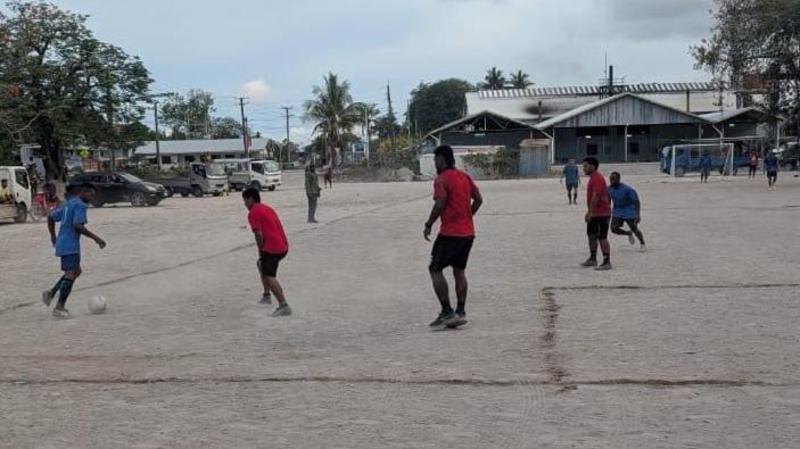
Much of the land is privately owned or uninhabitable, but volunteer Tyrone Deiye is hoping to use some of his family's land to create more pitches than the sole one that currently exists - a dusty surface of phosphate over crushed dirt. He also says playing on indoor pitches may be an option.
Pomroy is keen to stress that Nauru Soccer is not trying to "force football down everyone's throat" but says it's about laying a foundation for a sport, promoting healthy lifestyles and building communities.
"The life lessons that you learn through football aren't just on the pitch, not just about winning and losing," says Pomroy, who manages this project while coaching in India.
"It's the friends that you make. It is learning to be humble. It's learning to look after your body. It's learning to get up when you fall down.
"And that's how I've seen it change people across the world. That's the dream for Nauru.
"If we sat here in five years' time, I genuinely believe that we will have a senior team that will be filled with 18, 19, 20-year-olds.
"Then in 20 years' time, someone from Nauru comes up to me and says, 'my life changed through football and the development programme'... That would be the ultimate dream."
Other Pacific island nations play football and expats from these countries sometimes play on Nauru, although Deiye says Nauruans "watch the expats play but they sort of laugh at them because they don't understand the game, they think it's funny".
"A lot of the other Pacific islands have got really good football teams and it makes those guys really happy," adds Deiye, who balances work as an urban planner in Nauru alongside his football work. "Those countries, they're really big into football. I want Nauru to be like that."
Last year, the Marshall Islands played the US Virgin Islands in their first international match. The Pacific island had been the self-proclaimed last nation on earth without a football team, but Nauru have also been claiming this tag.
There was also confusion in the middle of the Covid pandemic when a fake domestic league in Nauru was announced, with the hoax being very detailed down to team names and registered players.
But the Nauru Soccer Federation now has a real website, where it outlines its plans and also sells a national team shirt to raise funds to grow the game. Its main source of money for the project is through fundraisers, but that can be difficult to organise as the volunteers are also balancing full-time work and different time zones.
Even communication between the project's team members can be tricky – sometimes Deiye will not be contactable for a couple of days, only to come back to say that a storm had wiped out the internet on the island.
"This project's not short of challenges, for sure," says Pomroy.
"I think from what I can understand, Nauruans have been promised quite a lot throughout their history and been let down many times.
"So their kind of attitude towards things tends to be 'we believe it when we see it' and they're very reluctant to get their hopes up.
"But in general, the feedback we get is everyone is very, very excited about it."
Source: BBC Sport · View original article ↗
This article has been sourced from an external provider and does not represent the views or opinions of AccaMate.